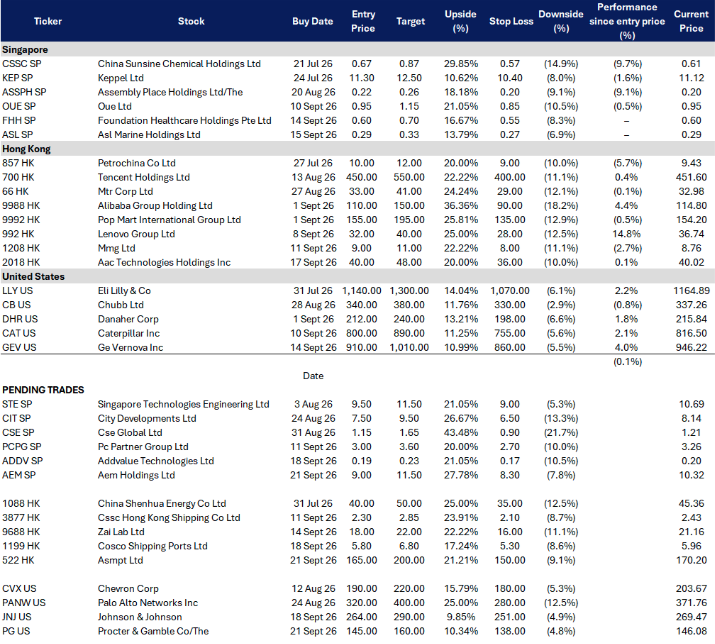

AEM SP
AI/HPC test intensity, customer diversification, and AMPS backlog conversion
KEY INSIGHTS #1
AI chips are driving structurally higher test intensity and expanding AEM’s addressable market.
AI accelerators and HPC processors are becoming larger, hotter and more complex, requiring longer test times, tighter thermal control and greater parallelism. This plays directly into AEM’s strengths in high-parallel test and active thermal management. 1H26 Test Cell Solutions revenue increased 52.5% YoY to S$180.9M and reached 73.2% of group revenue, while total revenue rose 29.9% to S$247.2M. AEM expects the semiconductor test-equipment market to grow from US$15.3B in 2026 to US$20.8B by 2028 as AI accelerators, stacked memory and heterogeneous chiplets increase test requirements.
KEY INSIGHTS #2
More than S$400M of AMPS backlog plus a memory ramp provides strong FY27 visibility.
AEM’s AMPS backlog exceeded S$400M in August, supported by orders from both its fabless AI/HPC customer and PC/Foundry customer. Management consequently raised FY26 revenue guidance for the second time this year to S$630–680M and guided EPS to 24.5–27.5 Singapore cents. The next leg comes from memory, with the first final-test handler scheduled for shipment in 4Q26 ahead of a production ramp in 2027. With AWX around S$9.1–9.4 versus DBS’s S$14.60 target, backlog conversion and successful memory qualification could drive another earnings-upgrade cycle.
.jpg)
ADDV SP
Space connectivity adoption, order-book visibility, and recurring airtime upside
KEY INSIGHTS #1
LEO satellite proliferation is driving greater demand for always-on space
Addvalue’s IDRS allows LEO satellites to communicate through geostationary relay networks rather than waiting for conventional ground-station passes, enabling near-real-time command and data transfer. Adoption continues to broaden: in June 2026, Addvalue secured US$5.1M of new IDRS orders from three customers, including one new customer, for Earth-observation and in-orbit servicing missions. This followed another US$2.9M of IDRS orders announced in April, while the company has continued securing additional contracts through September. The repeated wins support the thesis that IDRS is moving from early validation toward broader commercial adoption as satellite constellations scale.
KEY INSIGHTS #2
Revenue growth is increasingly backed by a larger and more diversified order pipeline.
FY26 revenue increased 59.9% YoY to US$24.8M, with more than 94% generated by the SPC and ADR businesses. SPC revenue rose 60.7%, while ADR revenue increased 56.4%, demonstrating that growth is no longer dependent on a single product line. Gross margin held at a strong 52.1%, while net profit more than doubled to US$4.8M from US$2.0M. The June IDRS wins lifted the order book to US$23.35M, and a further US$5M of SPC and ADR orders announced on 4 September improves FY27 revenue visibility further.

522 HK
Advanced packaging acceleration, TCB order momentum, and photonics upside
KEY INSIGHTS #1
AI packaging complexity is driving a broad-based backend equipment upcycle.
AI accelerators, HBM, chiplets and 2.5D/3D integration increasingly require more advanced packaging rather than relying solely on front-end transistor scaling. ASMPT is directly exposed through TCB, hybrid bonding, high-precision die bonding and photonics. 1H26 advanced-packaging revenue reached a record US$339M, +17% YoY and around 30% of group revenue, while photonics revenue nearly tripled as customers ramped 800G-and-above optical transceivers. This gives ASMPT diversified exposure to AI infrastructure across compute, memory and optical connectivity rather than a single packaging technology.
KEY INSIGHTS #2
Bookings suggest the earnings cycle still has room to run.
2Q26 bookings surged 97.6% YoY to US$903.6M, taking 1H26 bookings to US$1.63B and lifting book-to-bill to 1.43x, the highest since 1H21. Revenue rose 52.1% YoY in 2Q26 to US$630M, while adjusted gross margin expanded to 42.5% and adjusted net profit more than tripled to HK$637.5M. Importantly, ASMPT secured bulk orders for more than 50 chip-to-substrate TCB tools from OSAT customers for advanced AI chips, providing tangible evidence that TCB adoption is moving from qualification into volume deployment.
1199 HK
Throughput growth, overseas terminal scaling, and Chancay optionality
KEY INSIGHTS #1
Global container throughput remains resilient despite softer shipping profitability.
COSCO SHIPPING Ports handled 80.2M TEU in 1H26, +7.9% YoY, while equity throughput increased 7.0% to 24.5M TEU. Revenue rose 12.3% to US$905M and attributable profit increased 28.5% to US$234M, showing operating leverage despite a more difficult shipping backdrop. The key distinction versus container shipping lines is that ports earn primarily from throughput and terminal services, making 1199 HK less directly exposed to falling freight rates while still benefiting from sustained global trade volumes.
KEY INSIGHTS #2
Overseas terminals are becoming a larger and faster-growing earnings engine.
Overseas throughput increased 18.0% YoY to 21.1M TEU in 1H26 and now represents 26.4% of group throughput, while overseas equity throughput rose 12.4% and accounts for 30.9% of the total. This geographical diversification is increasingly important as it reduces dependence on mature Chinese port volumes and gives COSCO exposure to faster-growing trade corridors. There are still pockets of weakness, with Piraeus throughput down 2.9% and Abu Dhabi down 44.3% due partly to Middle East disruptions, but the broader overseas portfolio continues to expand faster than the domestic network.

PG US
Defensive consumer-staples compounder supported by resilient cash generation
KEY INSIGHTS #1
Essential categories provide resilience in a high-rate, inflationary environment.
P&G offers defensive exposure as elevated bond yields, persistent inflation and uncertainty around the Fed keep pressure on more cyclical consumer spending. Demand across everyday categories such as household care, grooming and personal care is relatively stable, while P&G’s brand strength and pricing power help offset input-cost inflation, making earnings and cash flows comparatively resilient even as lower-income consumers become more selective. Recent U.S. inflation and higher energy costs reinforce the value of this defensive earnings profile.
KEY INSIGHTS #2
Brand leadership and cash generation underpin shareholder returns.
P&G’s portfolio of category-leading brands continues to generate substantial cash flow, with FY26 operating cash flow of US$19.6bn and more than US$15bn returned to shareholders through dividends and buybacks. The company has now increased its dividend for 70 consecutive years, while ongoing productivity and portfolio discipline support its ability to protect margins and sustain capital returns despite a tougher consumer and cost environment.

JNJ US
Defensive healthcare leader with oncology and cardiovascular growth engines
KEY INSIGHTS #1
Non-cyclical healthcare demand supports earnings resilience.
Healthcare demand is less economically sensitive than discretionary consumption, making Johnson & Johnson relatively defensive in a high-interest-rate environment. Ageing populations, rising treatment intensity and continued demand for innovative medicines and medical procedures provide structural growth, while the company’s mix of pharmaceuticals and MedTech reduces reliance on any single end market.
KEY INSIGHTS #2
Innovative medicines and cardiovascular devices sustain above-market growth.
Johnson & Johnson’s 2Q26 sales rose 6.6% YoY to US$25.3bn, driven by continued strength in oncology products including DARZALEX, CARVYKTI, TECVAYLI and RYBREVANT, while MedTech operational sales grew 3.6%, supported by cardiovascular products including electrophysiology and Shockwave. This combination of high-growth innovative medicines and expanding cardiovascular technologies gives J&J a stronger growth profile than a traditional defensive healthcare stock.
STOCKS
–
STOCKS
–
STOCKS