Sector Performance | Singapore | Hong Kong | United States | Trading Dashboard

United States

Hong Kong


BUY
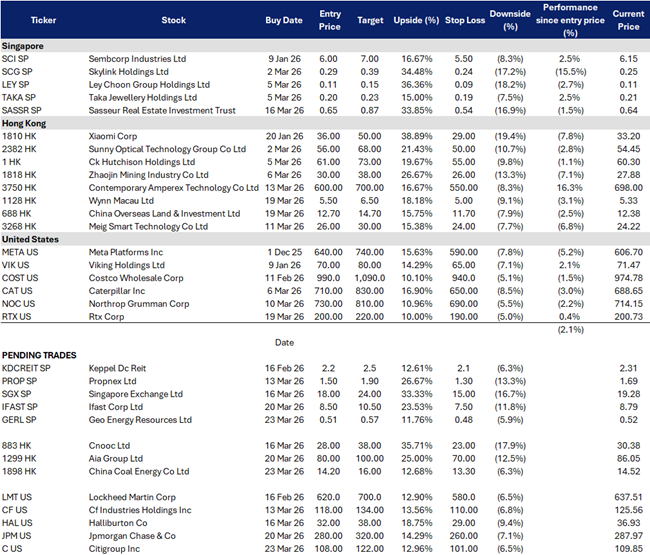
Geo Energy Resources Ltd (GERL SP)

| Entry: 0.51 Target: 0.57 Stop Loss: 0.48 |
| Execution-driven inflection amidst current coal upcycle |
| Key Insights |
- Coal price recovery supported by energy security and system reliability dynamics. Coal prices have rebounded in early 2026, with Indonesian 5,000 kcal coal at ~US$72/t and higher-grade coal at ~US$135/t, driven by LNG supply disruptions and fuel switching across Asia. Beyond cyclical recovery, coal demand is increasingly underpinned by energy security priorities, system reliability requirements, and policy support mechanisms, providing a more durable demand floor.
- MBJ infrastructure to drive structural cost savings and unlock scale. The US$150mn MBJ Integrated Infrastructure Project has reached 77% completion (as of Feb 2026) and is on track for commissioning in mid-2026. With total handling capacity of ~50Mt per annum, MBJ is expected to deliver meaningful transportation cost savings while supporting TRA production ramp-up toward 20-25Mt per annum. Notably, Geo Energy has increased its effective interest in MBJ to 71.3%.
- KGI’s coverage on Geo Energy can be found here.
RE-ITERATE BUY
iFAST Corporation Ltd (IFAST SP)

| Entry: 8.5 Target: 10.5 Stop Loss: 7.5 |
| Recurring AUA compounder, bank turns profitable, and platform scale is back |
| Key Insights |
- Recurring fee tailwind is back as AUA and flows reaccelerate. The core setup is a higher quality risk asset tape plus platform share gains. Management highlighted FY2025 profitability was driven by continued growth in the core wealth management platform and the Hong Kong ePension business, which is consistent with a recurring revenue model that scales with AUA and customer activity.
- Bank inflection is the rerating lever, not just an incremental business line. iFAST Global Bank delivered its first full year of profitability in FY2025 with profit before tax of S$3.11M, after a FY2024 loss. This matters because the market has historically discounted the group on the view that banking would be a drag. A credible profitability run rate can compress the conglomerate discount and improve valuation support through cycles.


BUY
China Coal Energy Co Ltd (1898 HK)

| Entry: 14.2 Target: 16.0 Stop Loss: 13.3 |
| Energy security tailwinds and domestic supply strength support coal demand |
| Key Insights |
- LNG disruption is pushing Asian utilities back toward coal. Asian utilities are raising coal-fired generation as LNG shipments through the Strait of Hormuz have been severely disrupted and Asian spot LNG prices have surged to multi-year highs, with countries including Bangladesh, Pakistan, the Philippines, Vietnam, Thailand, South Korea, and Japan all increasing coal usage or maintaining high coal utilisation to protect power supply and reduce fuel costs. For China Coal Energy, this strengthens the near-term case for thermal coal demand and pricing support, especially as coal remains a key energy-security fuel across Asia when gas markets become volatile.
- China’s domestic coal system remains strategically important despite the renewable buildout. Even though China continues to add renewables at scale, coal remains central to energy security, with 291GW of coal capacity still in the development pipeline at the end of 2025 and China’s coal output expected to rise to 4.86 billion tons in 2026. That backdrop supports domestic coal miners such as China Coal Energy, as policymakers continue to rely on coal for reliability and system flexibility, particularly when external energy shocks threaten imported fuel supply.
RE-ITERATE BUY
AIA Group Ltd (1299 HK)

| Entry: 80 Target: 100 Stop Loss: 70 |
| Pan-Asia life and health insurer with leading franchises across Hong Kong, China, Thailand, Singapore and other Asian markets |
| Key Insights |
- Asia protection cycle is re-rating again, and AIA is printing record new business. AIA delivered record 2025 VONB of US$5.516B (+15%) with operating ROEV 15.8% and EV equity US$79.7B, up 14% per share on an actual exchange rate basis. The macro set-up remains supportive: protection and health remain under-penetrated across Asia, while rates and risk appetite are stabilising, which tends to sustain savings and protection demand in AIA’s core markets.
- Capital return is a credible re-rating tool, not just a yield story. Alongside the record VONB print, AIA announced a US$1.7B share buyback and raised the final dividend to 144.08 HK cents (up from 130.98 HK cents previously). This matters because AIA’s valuation tends to respond when management pairs growth with visible capital return, tightening the floor for the equity even if China macro stays choppy.

BUY
Citigroup Inc (C US)

| Entry: 108 Target: 122 Stop Loss: 101 |
| Improving operating efficiency with stable rate tailwinds |
| Key Insights |
- A steadier Fed path supports NII stabilization instead of further margin pressure. The Fed’s decision to hold rates at 3.50%-3.75% and the market’s move to push expected easing further out improve the case for Citi’s NII to stabilize rather than keep falling. Citi’s Q4 net interest income rose 14%, showing that its earnings are still responding well to a less aggressive easing cycle, and a higher-for-longer rate backdrop should help offset some of the pressure investors previously expected from a faster decline in rates.
- Restructuring is improving the earnings mix and narrowing the gap to peers. Citi’s turnaround is adding a second support pillar beyond rates, Q4 investment-banking fees rose 35% and banking revenue climbed 78%, while headcount reduction, automation and regulatory progress continue to simplify the franchise and improve efficiency. With the workforce already down from 240,000 in 2022 to 226,000 by end-2025, Citi is increasingly positioned to convert stable NII plus better cost discipline into improved profitability and valuation rerating.
RE-ITERATE BUY
JPMorgan Chase & Co (JPM US)

| Entry: 280 Target: 320 Stop Loss: 260 |
| Stable rates support NIM resilience |
| Key Insights |
- Stable Fed rates should keep NIM firm. The Fed kept rates at 3.50%-3.75% on March 18 and still signalled only one cut this year, while raising its 2026 PCE inflation forecast to 2.7% and maintaining a cautious stance because of the Iran war and oil-price uncertainty. That matters for JPM because a slower easing path reduces the risk of another leg down in margins; management already expects 2026 NII excluding Markets of about US$95bn, and Q4 NII rose 7% to US$25.1bn, suggesting NIM should remain relatively stable.
- Payments and market-share gains add growth even without falling rates. JPM is not relying only on rate cuts, its trading franchise remained strong and it continues to deepen fee-based growth through payments and commercial cards, including the new virtual card launch in Europe with Mastercard. That gives JPM another lever for earnings growth if rates stay higher for longer, while its scale across cards, treasury services, prime brokerage and investment banking helps defend returns even in a flatter-rate environment.


TAKE PROFIT
–
ADD
- RTX Corp. (RTX US) at US$200
CUT
–