
FEH SP
Capacity-led growth, Central Asia acceleration
KEY INSIGHTS #1
Emerging-market coffee demand remains resilient despite elevated input costs.
Food Empire continues to benefit from structurally rising instant-coffee consumption across emerging markets, particularly Russia and Central Asia, where its brands already hold strong positions. 1H26 revenue grew 15.0% YoY to US$315.1M, led by Russia at +24.6% to US$103.2M and Central Asia at +33.6% to US$60.5M. Importantly, growth was not purely FX-driven, with management citing higher sales volumes, new distribution channels and sustained brand investment. This provides evidence that demand and pricing power are absorbing elevated coffee input costs better than feared.
KEY INSIGHTS #2
Capacity is becoming the next leg of the earnings growth cycle.
Food Empire is entering its most significant capacity expansion phase in years. Its new Kazakhstan coffee-mix facility is expected to ramp from 2H26, while India’s spray-dried soluble coffee capacity is being expanded by around 60% by end-2027 and a new freeze-dried coffee facility in Vietnam is targeted for 2028. This is important because the existing India facilities were already operating near full utilisation in 1H26, meaning current growth is increasingly capacity-constrained. New plants should therefore unlock incremental volume rather than merely replace existing capacity.

ASSPH SP
Asset-light key growth, new living verticals, and Phoenix Park as the next scale catalyst
KEY INSIGHTS #1
The growth story is broadening beyond conventional co-living.
TAP ended FY25 with 3,422 keys across 100 properties, versus 2,106 keys at end-FY24, while average occupancy improved to 94.4% from 91.0%. It already commands about 34% of Singapore’s co-living market by keys and targets more than 10,000 keys by end-2030. More importantly, 2026 expansion is no longer just adding ordinary rooms. TAP has moved into migrant-worker accommodation through a 60:40 JV with S11, adding 886 beds, while also expanding into hotels and other living formats.
KEY INSIGHTS #2
FY25 proves the asset-light model can scale, but watch the lease mix.
FY25 revenue increased 42.4% YoY to S$27.0m, while net profit rose 6.4% to S$6.6m. Excluding approximately S$1.1m of non-recurring IPO expenses, adjusted NPAT increased 24.2% to S$7.7m. The key operating metric is occupancy: 94.4% alongside rapid key expansion suggests TAP has so far been able to add supply without sacrificing utilisation. Community-Driven Stays generated 93.3% of FY25 revenue, with segment revenue rising 41.9% to S$25.2m.

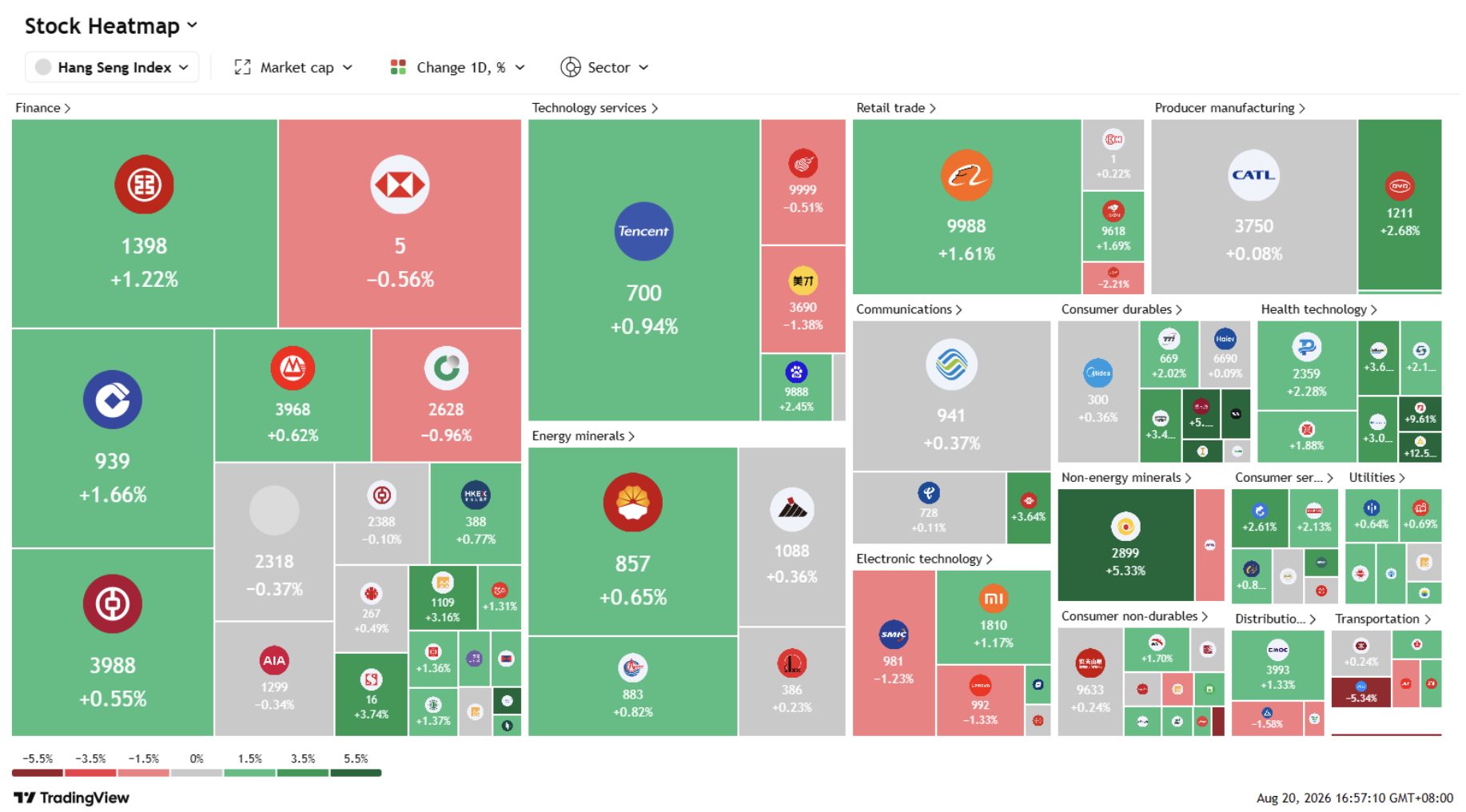
388 HK
IPO revival, Stock Connect liquidity, and market reform optionality
KEY INSIGHTS #1
Hong Kong’s capital-market revival is translating into structurally higher trading and IPO activity.
Hong Kong has regained momentum as a major global fundraising venue, supported by renewed Mainland issuance, AI and technology listings and stronger international investor participation. H1 2026 cash-market ADT reached HK$283B, +17.8% YoY and more than double FY24 levels, while IPO proceeds increased about 92% YoY to HK$210–212B. HKEX consequently delivered record 1H26 net profit of HK$10.57B, +24% YoY. With Hong Kong ranking as the world’s second-largest IPO venue in 1H26, sustained primary-market activity should continue feeding secondary-market turnover and listing-related revenues.
KEY INSIGHTS #2
Listing reforms and new RMB products can extend the earnings cycle beyond cash equities.
HKEX lowered several listing thresholds in July 2026 and expanded confidential IPO filings to all applicants, reducing friction for overseas, technology and dual-class-share issuers. At the same time, the August launch of five-year China Government Bond futures creates the offshore market’s only listed CGB futures contract, extending HKEX further into RMB rates and institutional risk management. Together with potential T+1 settlement and continuing market-structure reforms, these initiatives provide upside optionality if HKEX succeeds in converting today’s equity-market recovery into a broader multi-asset franchise.

992 HK
AI server inflection, PC pricing power, and a US$54bn AI pipeline
KEY INSIGHTS #1
AI infrastructure has reached an inflection point — US$54bn pipeline changes the earnings narrative.
Management reiterated a 550,000-unit FY27 1Q results were substantially stronger than expected. Revenue surged 43% YoY to US$26.94bn, versus consensus around US$22.3bn. AI-related revenue increased 60% to US$9.3bn and now represents roughly 35% of group revenue. More importantly, Lenovo disclosed an AI-server pipeline of US$54bn, +157% QoQ. This is the number I would focus on. Lenovo is increasingly participating in the AI capex cycle through rack-scale servers, liquid cooling, storage and infrastructure integration rather than simply selling PCscontributor rather than an R&D drag.
KEY INSIGHTS #2
Memory inflation is surprisingly becoming a pricing-power test rather than an earnings killer.
The obvious bear case is rising DRAM and NAND prices. Lenovo is one of the world’s largest memory purchasers, so the current memory shortage should theoretically squeeze hardware gross margins. So far, Lenovo is managing it better than expected. Management is using its global procurement scale, diversified sourcing and PC price increases to offset component inflation. Despite memory shortages, last quarter delivered adjusted net income of US$1.075bn, more than doubling YoY.

CRWD US
AI-security demand, Falcon platform consolidation
KEY INSIGHTS #1
Agentic AI is expanding the cybersecurity attack surface and keeping security budgets structurally supported.
Enterprise AI adoption is creating new vulnerabilities across identities, endpoints, applications and autonomous agents, increasing the need for integrated security rather than standalone endpoint tools. CrowdStrike’s 2026 Threat Hunting work highlighted AI becoming embedded in modern adversary operations, while its Fal.Con 2026 conference sold out at a record pace with more than 10,000 attendees and 4,000 organizations.
KEY INSIGHTS #2
Falcon Flex is accelerating platform consolidation and improving wallet-share expansion.
The core upside is increasingly about selling more modules into the existing installed base rather than relying solely on new customer additions. Q1 FY27 ending ARR reached US$5.51B, +24% YoY, while net new ARR grew 32% to a record US$256M. Falcon Flex customers represented more than US$1.9B of ending ARR, with over 1,900 Flex accounts and 480 customers already “re-Flexing” at an average 26% ARR uplift. Adoption of six or more modules reached 51%, suggesting CrowdStrike is successfully positioning Falcon as a broader cybersecurity operating platform rather than a point-product vendor.
LITE US
AI optics bottleneck, 1.6T/CPO acceleration, but valuation now demands near-perfect execution
KEY INSIGHTS #1
Optics content per GPU cluster is structurally increasing.
AI clusters require rapidly increasing bandwidth between GPUs, racks and data centres. As speeds migrate from 400G/800G toward 1.6T and beyond, copper becomes progressively less practical across longer connections, increasing optical content. Lumentum’s 4Q26 numbers provide unusually strong evidence that this is already translating into demand: quarterly revenue reached US$1.01B, +109% YoY, while management’s September-quarter guidance jumped to US$1.225–1.275B.
KEY INSIGHTS #2
1.6T is the near-term earnings driver; CPO is the next content step-up.
The market tends to focus on CPO, but I would not make CPO the FY27 base case. The nearer-term earnings torque comes from conventional pluggable optics moving toward 1.6T, together with higher-speed EML and pump-laser demand. CPO then provides upside optionality. Instead of connecting switches and accelerators to remotely positioned optical modules, CPO moves optics much closer to the switching silicon. That requires highly reliable external laser sources, an area where Lumentum’s photonics expertise becomes particularly valuable.
STOCKS
–
STOCKS
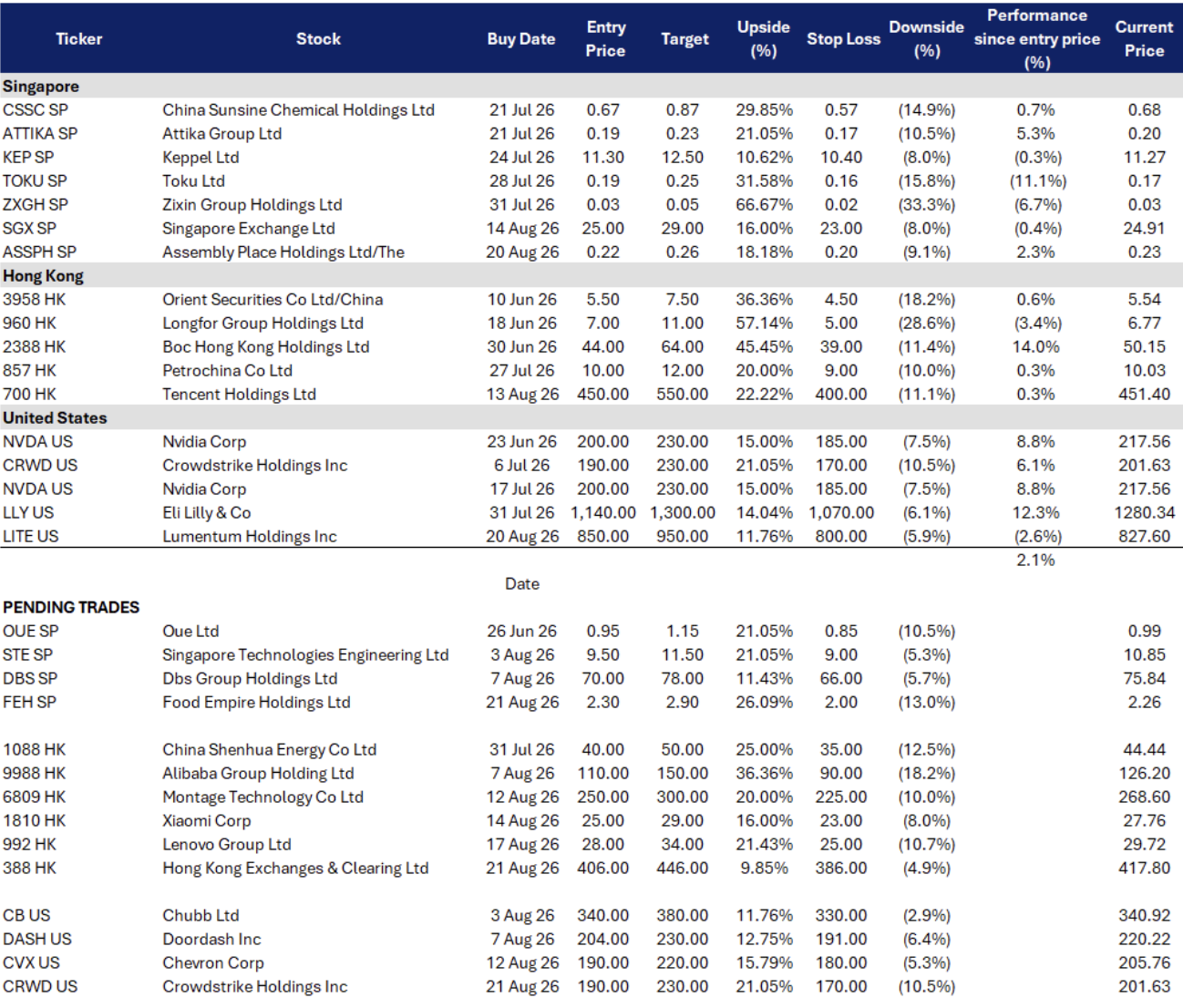
Assembly Place Holdings Ltd (ASSPH SP) at SG$0.22
Lumentum Holdings Inc. (LITE US) at US$850
STOCKS