
FHH SP
Specialist consolidation, margin recovery, and post-IPO rerating potential
KEY INSIGHTS #1
Singapore’s fragmented private specialist market creates a long runway for consolidation.
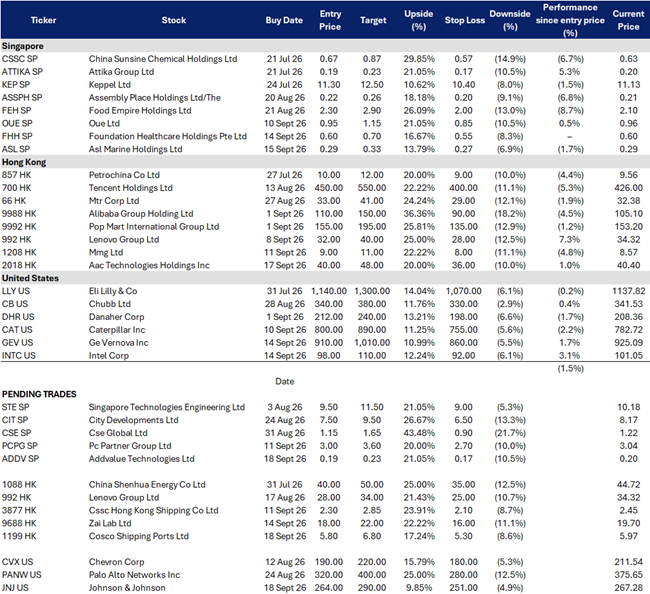
Foundation Healthcare held only 7.2% of Singapore’s private specialist market by revenue in FY25 despite already being the largest among key private specialist groups by specialist and clinic count. Its network expanded to 108 specialists by June 2026, with another four already joined or signed, while management expects acquisitions to resume in 2H26. 1H26 revenue grew 20.2% YoY to S$129.2M, with specialist services contributing S$125.7M, demonstrating that both recruitment and acquisitions continue to translate into topline growth.
KEY INSIGHTS #2
The post-IPO de-rating leaves a wide valuation gap if execution normalises.
Foundation listed at S$0.76 in July but has fallen to around S$0.64–0.65, roughly 15% below the IPO price despite continued double-digit revenue growth. The two current analyst targets average S$1.05, with a S$1.00–1.10 range, implying substantial upside if management delivers the expected margin recovery and restarts accretive M&A. The ownership structure also becomes cleaner from 2H26 because all specialist practices are now 100%-owned by Foundation, eliminating minority interests from those practices and improving future earnings attribution to shareholders.
.jpg)
ADDV SP
Space connectivity adoption, order-book visibility, and recurring airtime upside
KEY INSIGHTS #1
LEO satellite proliferation is driving greater demand for always-on space
Addvalue’s IDRS allows LEO satellites to communicate through geostationary relay networks rather than waiting for conventional ground-station passes, enabling near-real-time command and data transfer. Adoption continues to broaden: in June 2026, Addvalue secured US$5.1M of new IDRS orders from three customers, including one new customer, for Earth-observation and in-orbit servicing missions. This followed another US$2.9M of IDRS orders announced in April, while the company has continued securing additional contracts through September. The repeated wins support the thesis that IDRS is moving from early validation toward broader commercial adoption as satellite constellations scale.
KEY INSIGHTS #2
Revenue growth is increasingly backed by a larger and more diversified order pipeline.
FY26 revenue increased 59.9% YoY to US$24.8M, with more than 94% generated by the SPC and ADR businesses. SPC revenue rose 60.7%, while ADR revenue increased 56.4%, demonstrating that growth is no longer dependent on a single product line. Gross margin held at a strong 52.1%, while net profit more than doubled to US$4.8M from US$2.0M. The June IDRS wins lifted the order book to US$23.35M, and a further US$5M of SPC and ADR orders announced on 4 September improves FY27 revenue visibility further.

9688 HK
Pipeline maturation, commercial stabilization, and zoci catalyst density
KEY INSIGHTS #1
China innovative-biopharma sentiment is improving as locally developed assets gain global relevance.
Zai Lab is moving from a predominantly China licensing model toward developing globally relevant proprietary drugs. The clearest example is zoci, its DLL3-targeting ADC for small-cell lung cancer and neuroendocrine cancers, which has already received FDA Fast Track designation and orphan-drug designations from both the FDA and EMA. A global Phase 3 study is planned to start in 2H26, while first-line SCLC combination data are expected at ESMO 2026. Successful data would strengthen the case that Zai can create globally monetisable assets rather than simply commercialising imported drugs in China.
KEY INSIGHTS #2
Commercial revenue is stabilising ahead of a potential return to growth in 2027.
2Q26 revenue was US$106.3M, down modestly YoY but up sequentially, with net product revenue increasing 11% QoQ as ZEJULA stabilised and VYVGART delivered double-digit volume growth. KarXT has now launched in mainland China, while TIVDAK received NMPA approval in June, expanding the commercial portfolio further. Management expects the business to return to meaningful growth in 2027, which is important because a stronger commercial base can help fund the increasingly expensive global clinical pipeline. Zai also retained US$717.5M of cash and short-term investments at end-June.
1199 HK
Throughput growth, overseas terminal scaling, and Chancay optionality
KEY INSIGHTS #1
Global container throughput remains resilient despite softer shipping profitability.
COSCO SHIPPING Ports handled 80.2M TEU in 1H26, +7.9% YoY, while equity throughput increased 7.0% to 24.5M TEU. Revenue rose 12.3% to US$905M and attributable profit increased 28.5% to US$234M, showing operating leverage despite a more difficult shipping backdrop. The key distinction versus container shipping lines is that ports earn primarily from throughput and terminal services, making 1199 HK less directly exposed to falling freight rates while still benefiting from sustained global trade volumes.
KEY INSIGHTS #2
Overseas terminals are becoming a larger and faster-growing earnings engine.
Overseas throughput increased 18.0% YoY to 21.1M TEU in 1H26 and now represents 26.4% of group throughput, while overseas equity throughput rose 12.4% and accounts for 30.9% of the total. This geographical diversification is increasingly important as it reduces dependence on mature Chinese port volumes and gives COSCO exposure to faster-growing trade corridors. There are still pockets of weakness, with Piraeus throughput down 2.9% and Abu Dhabi down 44.3% due partly to Middle East disruptions, but the broader overseas portfolio continues to expand faster than the domestic network.

INTC US
AI CPU demand, 18A execution, and asset-monetisation optionality
KEY INSIGHTS #1
AI infrastructure is creating a second demand leg for server CPUs alongside GPUs.
Intel’s server outlook has strengthened materially as AI data centres require large numbers of host CPUs alongside accelerators. 2Q26 revenue rose 25% YoY to US$16.1B, marking Intel’s strongest revenue growth in more than 15 years, while management has guided for double-digit industry server-unit growth with momentum extending into 2027. This is important because Intel does not need to displace NVIDIA in accelerators to benefit from AI capex: Xeon remains embedded as the host CPU across large AI clusters, allowing DCAI to participate directly in expanding data-centre compute budgets.
KEY INSIGHTS #2
Altera IPO and balance-sheet restructuring provide near-term value-unlock catalysts.
Intel retains a 49% stake in Altera after selling control to Silver Lake at an US$8.75B valuation, and Reuters reported on 10 September that Altera is preparing an IPO that could raise more than US$2B as early as 2026. A successful listing could crystallise the value of Intel’s remaining stake while reinforcing CEO Lip-Bu Tan’s strategy of monetising non-core assets and focusing capital on CPUs, AI and Foundry. Intel has also raised roughly US$20B through an August equity offering, strengthening liquidity for its manufacturing programme. The trade-off is substantial dilution, but with INTC around US$101 after a sharp run from below US$90 at the start of September, a pullback toward US$95 offers a cleaner risk-reward entry ahead of further 18A and Altera catalysts.

JNJ US
Defensive healthcare leader with oncology and cardiovascular growth engines
KEY INSIGHTS #1
Non-cyclical healthcare demand supports earnings resilience.
Healthcare demand is less economically sensitive than discretionary consumption, making Johnson & Johnson relatively defensive in a high-interest-rate environment. Ageing populations, rising treatment intensity and continued demand for innovative medicines and medical procedures provide structural growth, while the company’s mix of pharmaceuticals and MedTech reduces reliance on any single end market.
KEY INSIGHTS #2
Innovative medicines and cardiovascular devices sustain above-market growth.
Johnson & Johnson’s 2Q26 sales rose 6.6% YoY to US$25.3bn, driven by continued strength in oncology products including DARZALEX, CARVYKTI, TECVAYLI and RYBREVANT, while MedTech operational sales grew 3.6%, supported by cardiovascular products including electrophysiology and Shockwave. This combination of high-growth innovative medicines and expanding cardiovascular technologies gives J&J a stronger growth profile than a traditional defensive healthcare stock.
STOCKS
–
STOCKS
STOCKS