
FHH SP
Specialist consolidation, margin recovery, and post-IPO rerating potential
KEY INSIGHTS #1
Singapore’s fragmented private specialist market creates a long runway for consolidation.
Foundation Healthcare held only 7.2% of Singapore’s private specialist market by revenue in FY25 despite already being the largest among key private specialist groups by specialist and clinic count. Its network expanded to 108 specialists by June 2026, with another four already joined or signed, while management expects acquisitions to resume in 2H26. 1H26 revenue grew 20.2% YoY to S$129.2M, with specialist services contributing S$125.7M, demonstrating that both recruitment and acquisitions continue to translate into topline growth.
KEY INSIGHTS #2
The post-IPO de-rating leaves a wide valuation gap if execution normalises.
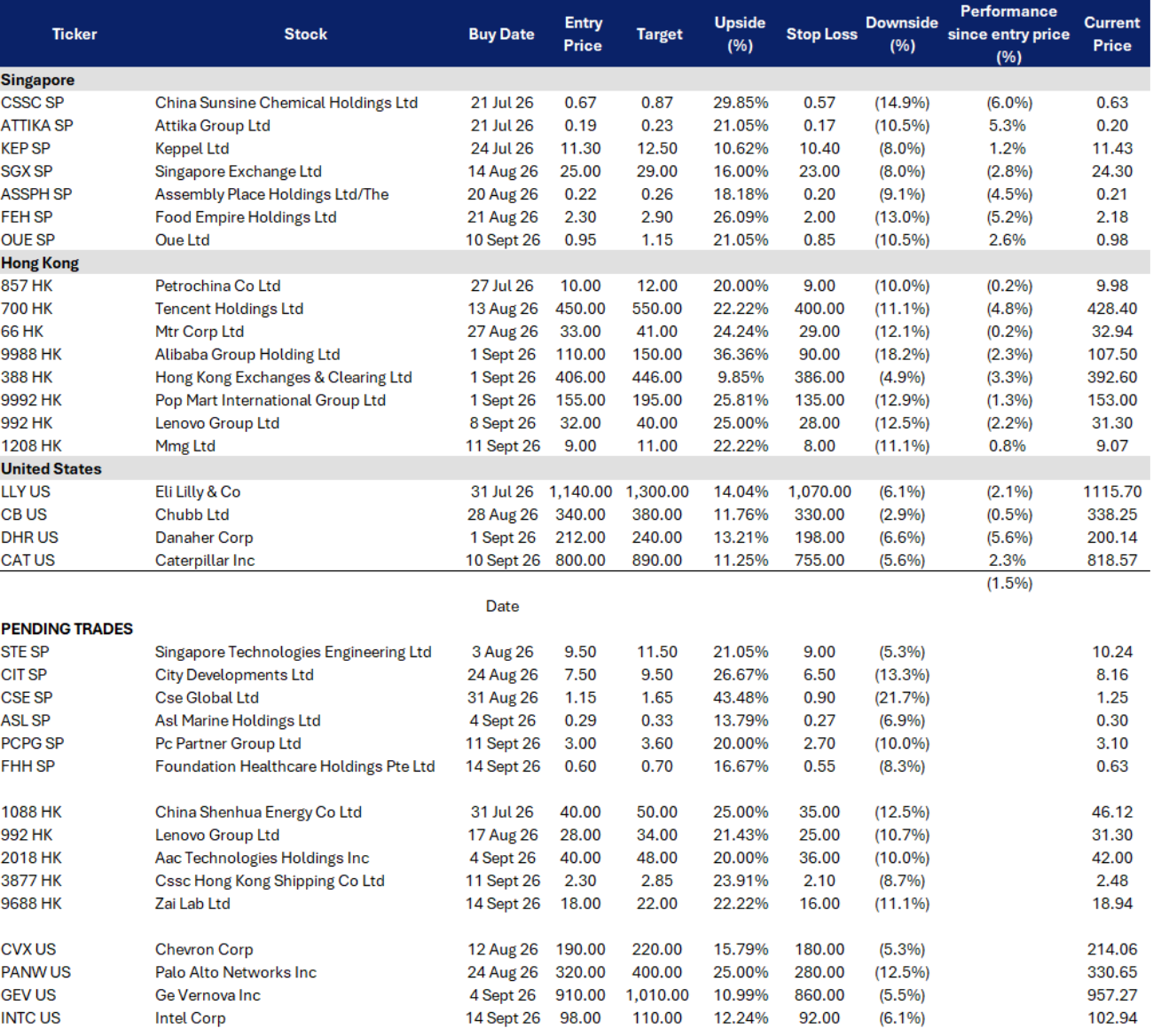
Foundation listed at S$0.76 in July but has fallen to around S$0.64–0.65, roughly 15% below the IPO price despite continued double-digit revenue growth. The two current analyst targets average S$1.05, with a S$1.00–1.10 range, implying substantial upside if management delivers the expected margin recovery and restarts accretive M&A. The ownership structure also becomes cleaner from 2H26 because all specialist practices are now 100%-owned by Foundation, eliminating minority interests from those practices and improving future earnings attribution to shareholders.

PCPG SP
GPU pricing power, AI-server optionality, and margin normalization
KEY INSIGHTS #1
Tight GPU and graphics-memory supply is supporting ASPs even as unit volumes remain constrained.
The current memory shortage is creating an unusual earnings setup for graphics-card manufacturers. In 1H26, PC Partner’s own-brand graphics-card revenue fell 9.2% to HK$4.46B as shipment volume declined 18.4%, but average selling prices increased 10.7%. More importantly, ODM/OEM graphics-card revenue jumped 73.9% to HK$1.48B despite a 38.4% volume decline because ASP increased 181%. Group revenue therefore still rose 1.5% YoY to HK$6.45B, while gross margin expanded sharply to 16.5% from 10.5%. PC Partner has previously indicated that higher graphics-memory prices should continue supporting VGA pricing until supply improves, creating a near-term buffer against lower unit output.
KEY INSIGHTS #2
AI servers provide a credible second growth engine beyond consumer GPUs.
PC Partner is transitioning from primarily an add-in-board GPU manufacturer toward higher-value enterprise compute. At NVIDIA GTC 2026, the group showcased a 4U NVIDIA MGX server using RTX PRO 6000 Blackwell Server Edition GPUs and ConnectX-8 networking, alongside a 6U eight-GPU server targeted at on-premise AI and digital-twin workloads. The 4U platform supports up to eight GPUs with 96GB of GDDR7 memory per card. Management has also indicated that 6U systems have already started shipping, while the MGX 4U server is expected to become available from September. Initial volumes are unlikely to transform group earnings immediately, particularly where systems are sold as lower-margin barebones, but successful qualification with system integrators and data centres could materially expand PC Partner’s addressable market beyond gaming GPUs.

9688 HK
Pipeline maturation, commercial stabilization, and zoci catalyst density
KEY INSIGHTS #1
China innovative-biopharma sentiment is improving as locally developed assets gain global relevance.
Zai Lab is moving from a predominantly China licensing model toward developing globally relevant proprietary drugs. The clearest example is zoci, its DLL3-targeting ADC for small-cell lung cancer and neuroendocrine cancers, which has already received FDA Fast Track designation and orphan-drug designations from both the FDA and EMA. A global Phase 3 study is planned to start in 2H26, while first-line SCLC combination data are expected at ESMO 2026. Successful data would strengthen the case that Zai can create globally monetisable assets rather than simply commercialising imported drugs in China.
KEY INSIGHTS #2
Commercial revenue is stabilising ahead of a potential return to growth in 2027.
2Q26 revenue was US$106.3M, down modestly YoY but up sequentially, with net product revenue increasing 11% QoQ as ZEJULA stabilised and VYVGART delivered double-digit volume growth. KarXT has now launched in mainland China, while TIVDAK received NMPA approval in June, expanding the commercial portfolio further. Management expects the business to return to meaningful growth in 2027, which is important because a stronger commercial base can help fund the increasingly expensive global clinical pipeline. Zai also retained US$717.5M of cash and short-term investments at end-June.

3877 HK
Shipping-rate resilience, long-duration leasing cash flow, and fleet expansion
KEY INSIGHTS #1
Elevated freight rates and tight shipyard capacity are supporting vessel values and leasing economics.
The shipping backdrop remains favourable across several vessel classes. In 1H26, the ClarkSea Index averaged US$39,043/day, +61% YoY, while the BDI increased 82% and tanker rates strengthened sharply amid longer voyage distances and geopolitical disruption. Newbuild demand is also elevated, with US$132.6B of global orders placed in 1H26 and core shipyard delivery slots extending to around 4.3 years. Higher charter rates and replacement costs support both the residual value of CSSC Shipping’s fleet and demand for third-party ship financing.
KEY INSIGHTS #2
A ten-vessel newbuild programme creates the next leg of asset and earnings growth.
On 1 September, CSSC Shipping agreed to acquire ten new vessels from China Shipbuilding Group-related yards for RMB3.24B, or approximately HK$3.78B, subject to shareholder approval. The transaction follows six new sale-and-leaseback projects worth US$324M signed during 1H26 and demonstrates that management is redeploying capital into a stronger shipping market rather than allowing the financing book to run down. With the shares around HK$2.32, the stock trades at roughly 6–7x forward earnings with a c.7% prospective dividend yield, while DBS recently set a HK$2.87 target. Continued fleet deployment and stable credit costs provide a credible path toward that valuation.

INTC US
AI CPU demand, 18A execution, and asset-monetisation optionality
KEY INSIGHTS #1
AI infrastructure is creating a second demand leg for server CPUs alongside GPUs.
Intel’s server outlook has strengthened materially as AI data centres require large numbers of host CPUs alongside accelerators. 2Q26 revenue rose 25% YoY to US$16.1B, marking Intel’s strongest revenue growth in more than 15 years, while management has guided for double-digit industry server-unit growth with momentum extending into 2027. This is important because Intel does not need to displace NVIDIA in accelerators to benefit from AI capex: Xeon remains embedded as the host CPU across large AI clusters, allowing DCAI to participate directly in expanding data-centre compute budgets.
KEY INSIGHTS #2
Altera IPO and balance-sheet restructuring provide near-term value-unlock catalysts.
Intel retains a 49% stake in Altera after selling control to Silver Lake at an US$8.75B valuation, and Reuters reported on 10 September that Altera is preparing an IPO that could raise more than US$2B as early as 2026. A successful listing could crystallise the value of Intel’s remaining stake while reinforcing CEO Lip-Bu Tan’s strategy of monetising non-core assets and focusing capital on CPUs, AI and Foundry. Intel has also raised roughly US$20B through an August equity offering, strengthening liquidity for its manufacturing programme. The trade-off is substantial dilution, but with INTC around US$101 after a sharp run from below US$90 at the start of September, a pullback toward US$95 offers a cleaner risk-reward entry ahead of further 18A and Altera catalysts.

CAT US
Broad industrial beneficiary of AI infrastructure, construction and power demand
KEY INSIGHTS #1
Expanding from heavy equipment into power and AI-enabled industrial systems.
Caterpillar’s growth is broadening beyond traditional construction and mining equipment into power generation and digitally enabled industrial operations. In 2Q26, sales rose 24% YoY to US$20.5bn, with all three major segments growing and Power & Energy revenue increasing 17% to US$8.24bn; strong order rates and a rising backlog point to continued demand visibility. Its new collaboration with FieldAI, using robotics, digital twins and NVIDIA technologies, also strengthens Caterpillar’s push toward more autonomous and productive industrial operations.
KEY INSIGHTS #2
AI data centres and infrastructure spending expand demand for equipment and power.
The AI infrastructure buildout is creating demand not only for data-centre construction but also for backup generation, gas engines, turbines and supporting electrical infrastructure, complementing continued U.S. infrastructure and mining investment. This gives Caterpillar exposure across the physical buildout of AI capacity, from earthmoving and construction machinery to distributed power generation, extending its growth opportunity beyond the traditional machinery cycle.
STOCKS
–
STOCKS
STOCKS
–