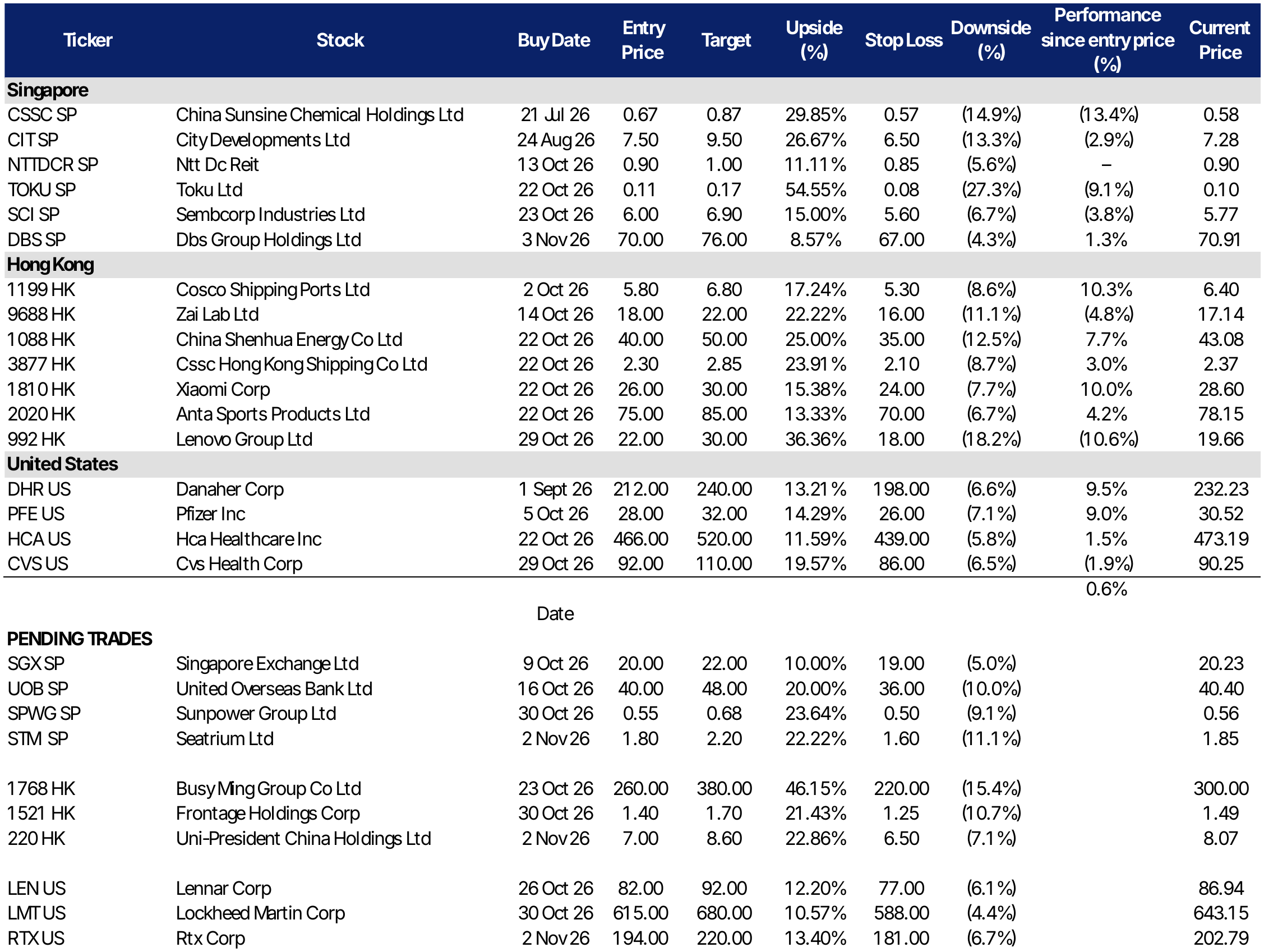

STM SP
Order replenishment, margin recovery, and execution credibility rebuild
KEY INSIGHTS #1
October order wins materially reduce concerns around backlog replacement
Seatrium has entered a strong order-award cycle after backlog declined to S$13.3B at end-June from S$17.8B at end-2025. On 26 October, RigCo awarded more than S$500M of work to complete four offshore rigs, while on 30 October Seatrium secured another FPSO integration contract worth over S$200M from SBM Offshore for a South American project, with execution beginning in 4Q26 through 2029. This follows October awards for five Karpowership Whale Class Powership conversions and an Excelerate Energy FSRU conversion. The breadth of FPSO, drilling, LNG and floating-power wins suggests Seatrium is replenishing backlog beyond its large Petrobras contracts and reduces the risk that revenue falls sharply once the current FPSO programme matures.
KEY INSIGHTS #2
19 November business update and S$200M buyback create near-term rerating catalysts
Seatrium will release its 3Q26 business update before market open on 19 November, with investors likely focused on updated order book, margin progression and the conversion of its more than S$32B opportunity pipeline. Management has also doubled its share-repurchase programme to S$200M and continues buying stock around current levels, including purchases at approximately S$1.83 in October. With the shares now around S$1.84 versus above S$2.20 in September, expectations have reset substantially despite accelerating contract wins. A 3Q update demonstrating continued margin improvement and order-book stabilisation could support a recovery toward S$2.20
SPWG SP
Steam-volume growth, margin normalisation, and transaction optionality
KEY INSIGHTS #1
Industrial upgrading and environmental tightening continue to support centralised clean-steam demand
China’s continued relocation of industrial activity into designated industrial parks, tighter environmental standards and replacement of smaller inefficient boilers structurally favour centralised utility providers such as Sunpower. This is already translating into volumes: 1H26 total steam sales rose 12.7% YoY to 6.56M tonnes, including 13.1% growth in industrial steam, while GI recurring revenue increased 8.5% to RMB1.70B. With industrial steam a non-discretionary input for Sunpower’s diversified customer base, utilisation growth across existing plants provides a relatively defensive source of topline expansion even amid a softer Chinese macro environment.
KEY INSIGHTS #2
Ongoing confidential transaction discussions create a meaningful corporate-action catalyst
Sunpower first disclosed in August that confidential discussions were underway regarding a potential transaction involving the company’s ordinary shares. The board subsequently confirmed on 11 October that discussions remain ongoing, although no specific transaction has been agreed and there is no assurance that one will materialise. This introduces a potentially significant takeover or strategic-transaction catalyst on top of the operating recovery. At around S$0.565, the stock trades at roughly 8x trailing earnings and around book value, while remaining below its S$0.675 52-week high. An entry around S$0.55 provides a reasonable risk-reward for a move toward S$0.68 if margins recover and the transaction discussions progress.
220 HK
Premiumisation, margin resilience, and defensive yield
KEY INSIGHTS #1
Value conscious consumption is favouring affordable packaged food while noodle premiumisation remains resilient
China’s consumer environment remains subdued, but spending is increasingly shifting toward affordable quality and products offering clear value for money, which is comparatively supportive for Uni President’s mass market portfolio. In 1H26, food revenue increased 4.7% YoY to RMB5.63B, driven by continued strength in higher value noodle brands such as King of Tomato and Imperial Big Meal, while the latter delivered high double digit revenue growth. Beverage demand was softer, declining 0.3%, but the diversification between food and beverages provides greater defensiveness than a pure discretionary consumer name.
KEY INSIGHTS #2
Product mix is allowing profit to grow substantially faster than revenue
1H26 group revenue increased only 1.4% YoY to RMB17.32B, but gross margin expanded 0.7ppt to 35.0%, operating profit increased 9.5% to RMB1.80B and attributable profit rose 9.0% to RMB1.40B. The divergence reflects continued premiumisation in noodles, tighter product portfolio management and disciplined cost control. This is important because the investment case does not require a major Chinese consumption recovery. Even low single digit revenue growth can still translate into mid to high single digit earnings growth if mix improvement continues.

1521 HK
CRO recovery, contract backlog growth, and takeover optionality
KEY INSIGHTS #1
Biopharma R&D recovery is translating into accelerating contract wins
Frontage’s 1H26 revenue increased 17.1% YoY to US$148.2M, while adjusted EBITDA rose 22.8% to US$34.5M and adjusted net profit surged 74.0% to US$13.4M. More importantly, contracted future revenue reached US$543.2M at June, +34.2% YoY, materially ahead of current revenue growth and providing stronger visibility into 2H26 and FY27. North America and Europe revenue increased 7.8%, while China revenue grew 43.6% in constant currency as utilisation recovered and the Teddy Lab acquisition contributed. This suggests the CRO cycle is moving from stabilisation toward renewed growth.
KEY INSIGHTS #2
The unexplained Takeovers Code suspension creates a potentially significant corporate-action catalyst
Frontage requested a trading halt from 9:00am on 22 October specifically pending an announcement under Hong Kong’s Code on Takeovers and Mergers containing inside information. No consideration, buyer or transaction structure has been disclosed as of 29 October, meaning the event remains binary. The setup is nevertheless notable because controlling shareholder Hangzhou Tigermed already holds approximately 64.6% of Frontage, making a parent-led privatisation or other control transaction one plausible scenario, although this has not been confirmed. The last traded price was HK$1.49, already near the 52-week high, so I would not chase a large reopening gap. The better setup is below HK$1.45 if the transaction announcement does not already establish a higher cash offer price.

RTX US
Diversified aerospace and defense platform benefiting from missile demand and commercial aftermarket growth
KEY INSIGHTS #1
Rearmament and aircraft scarcity support both sides of RTX’s portfolio.
RTX benefits from two structural spending cycles at once: rising defense budgets are supporting demand for Patriot, AMRAAM, Tomahawk and other missile systems, while persistent shortages of new aircraft and engines are forcing airlines to operate existing fleets at high utilisation rates and sustain maintenance spending. IATA estimates the industry is effectively short roughly 3,170 aircraft, while NATO’s higher spending commitment supports continued defense procurement, creating a favourable backdrop for both Raytheon and the commercial aftermarket businesses at Pratt & Whitney and Collins Aerospace.
KEY INSIGHTS #2
Record backlog and improving segment profitability support stronger cash flow.
RTX’s diversified model is translating this demand into stronger operating performance, with 3Q26 sales rising 11% YoY to US$25.0bn and backlog reaching a record US$340bn, split between US$176bn commercial and US$164bn defense. Raytheon sales grew 14% on stronger Patriot, Standard Missile and Tomahawk volumes, Pratt & Whitney commercial aftermarket revenue rose 21%, and Collins commercial aftermarket sales increased 9%; improving productivity helped RTX raise FY26 adjusted EPS and free-cash-flow guidance to US$7.65–7.75 and US$9.0–9.2bn, respectively.

LMT US
Missile-defense and F-35 prime leveraged to allied rearmament
KEY INSIGHTS #1
Air-defense replenishment and higher NATO spending create a multi-year demand cycle
Global defense spending is moving structurally higher as the U.S. and its allies rebuild missile inventories and expand layered air and missile-defense capabilities. NATO members have committed to spend 5% of GDP on defense and defense-related investment by 2035, while European Allies and Canada already increased combined real defense expenditure by nearly 20% in 2025; this creates a particularly strong backdrop for Lockheed’s PAC-3 MSE and THAAD interceptors as governments replenish stocks and expand air-defense capacity.
KEY INSIGHTS #2
Record backlog and multiyear awards materially improve revenue visibility
Lockheed’s execution is increasingly backed by long-duration contracts, with 3Q26 sales rising 11% YoY to US$20.7bn and backlog reaching a record US$292bn, including US$52.5bn tied to the PAC-3 MSE multiyear award. PAC-3 production capacity is targeted to more than triple toward 2,000 interceptors annually, THAAD capacity is planned to rise from 96 to 400 per year, while the new F-35 framework covers 850 U.S. aircraft over 10 years plus sustainment and international orders, materially improving production and aftermarket visibility if fully contracted.
STOCKS
STOCKS
STOCKS