
UOB SP
ASEAN franchise growth, wealth-management momentum, and capital returns
KEY INSIGHTS #1
The recent Singapore-bank correction provides a cleaner entry despite resilient fundamentals.
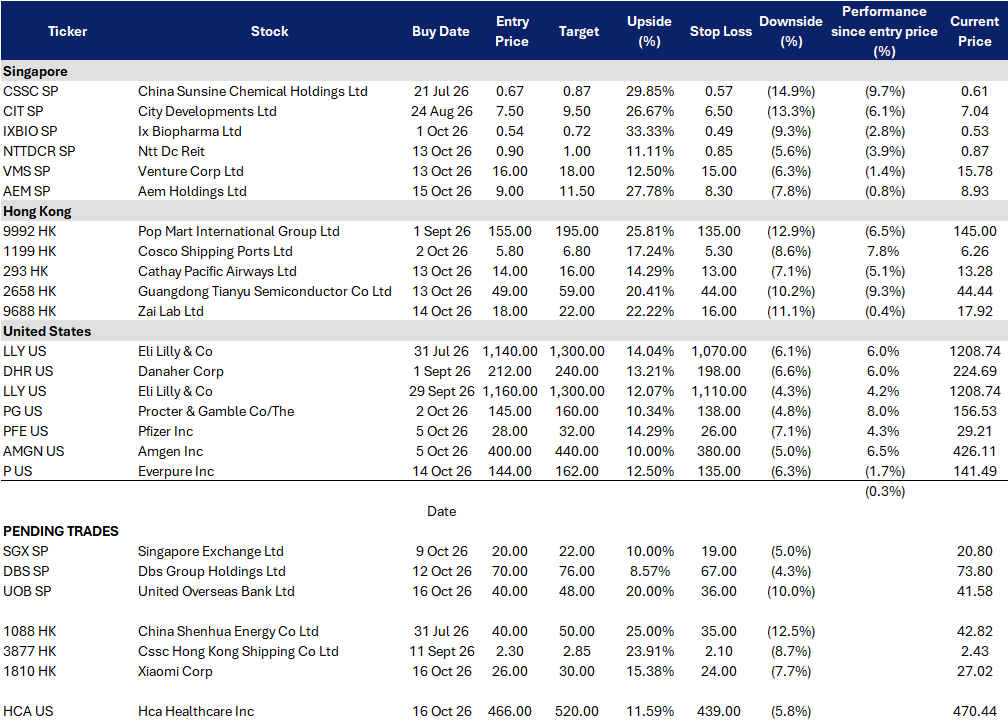
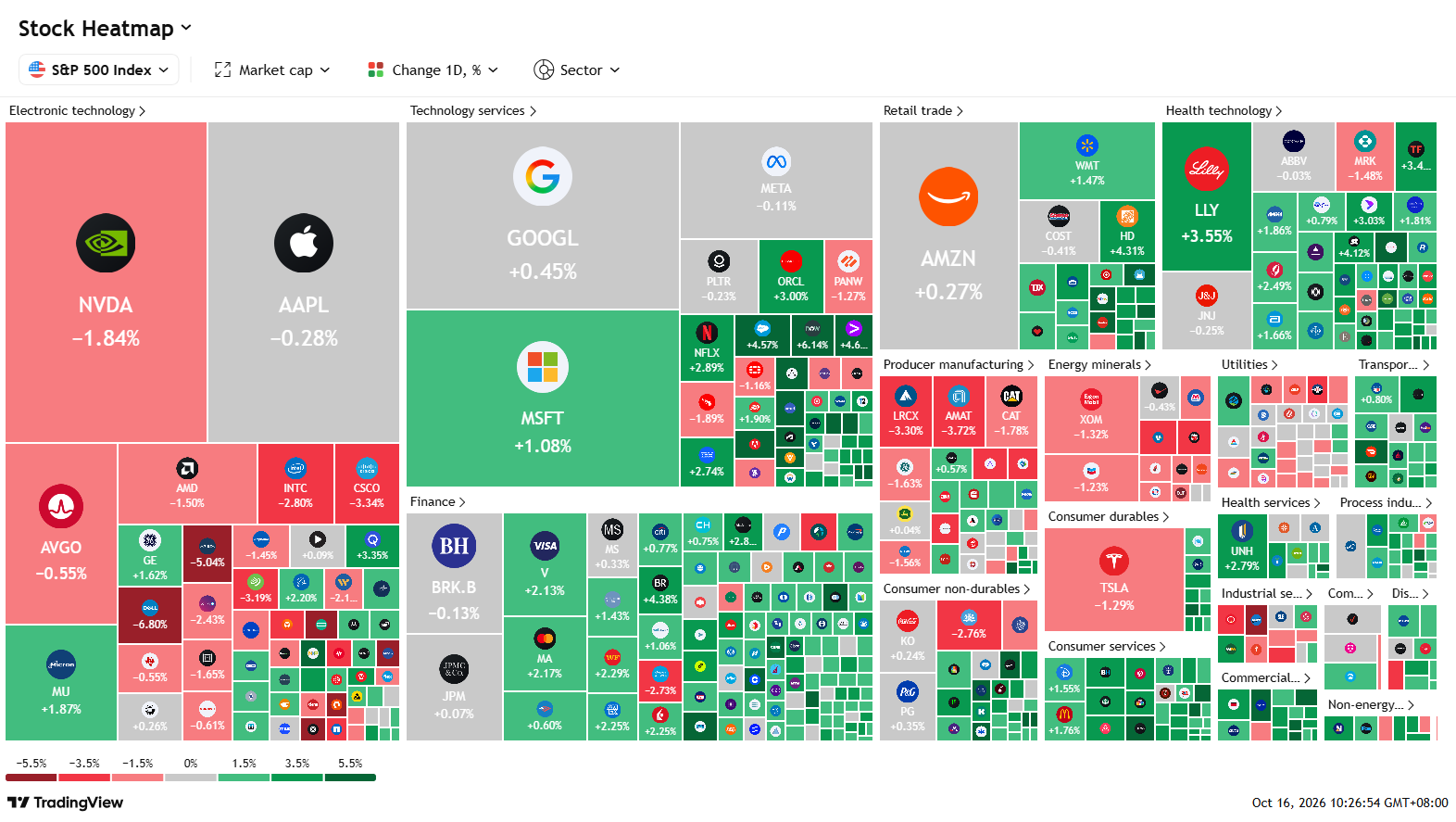
UOB fell from above S$43 in early October to S$40.25 on 8 October as Singapore banks sold off following Citi’s downgrade of OCBC, concerns around softer 3Q earnings and rising global bond yields. The move was largely sector-wide rather than UOB-specific. Operationally, 2Q26 net profit still increased 10% YoY to S$1.5B, while loans grew 5% despite NIM pressure. UOB has since recovered to around S$41.20, but remains below its recent highs, creating a more attractive entry ahead of its 3Q26 trading update on 4 November.
KEY INSIGHTS #2
Share buybacks and dividends provide tangible support through the earnings slowdown.
UOB maintained an interim dividend of S$0.88 per share, representing roughly a 50% payout ratio, while continuing its S$2B capital-return buyback programme. Around 40% of the programme had already been completed by July, and purchases are continuing in October, including 70,000 shares bought and cancelled on 12 October around S$40. UOB also retains a strong 15.4% CET1 ratio, giving it capacity to sustain capital returns even as NIM normalises. With RHB’s latest target at S$47.60, an entry around S$40.80 offers roughly 16% upside before dividends if 3Q earnings demonstrate that fee growth and ASEAN momentum can offset margin pressure.

DBS SP
Wealth-management compounding, NIM resilience, and post-selloff reset
KEY INSIGHTS #1
The sharp Singapore-bank selloff creates a better entry while the macro backdrop remains supportive.
DBS fell 4.7% on 8 October and traded around S$73 on 9 October after a sector-wide selloff triggered by profit-taking, elevated valuations, rising global bond yields and concerns over bank funding costs. The move looks more like a valuation reset than a deterioration in DBS’s fundamentals. Singapore’s economy remains strong, while renewed global inflation and higher-rate expectations reduce the downside risk to bank margins from aggressive monetary easing. DBS also enters this environment with the strongest profitability among the local banks, making the current correction a more attractive entry after the stock fell from its S$79.05 52-week high.
KEY INSIGHTS #2
Wealth management is increasingly offsetting pressure from lower net interest margins.
2Q26 net profit rose 9% YoY to a record S$3.08B despite NIM falling 18bps to 1.87%. The key driver was non-interest income: net fees increased 25% to S$1.46B, with wealth-management fees surging 42% to a record S$919M, while wealth AUM reached S$516B, +16% in constant-currency terms. Loans also grew 8% YoY and deposits 11%, helping offset rate compression. This matters because DBS is gradually becoming less dependent on the traditional NIM cycle, with wealth, treasury customer sales and markets income providing a larger structural earnings contribution.

1810 HK
EV scaling, smartphone-margin recovery, and AI-chip optionality
KEY INSIGHTS #1
EV growth is becoming increasingly important as the smartphone industry enters a difficult downcycle
Global smartphone shipments fell 20% YoY in 3Q26, with Xiaomi shipments dropping more than 30% as memory shortages and rising component costs forced manufacturers to prioritise profitability over low-end volumes. However, Xiaomi’s diversification is increasingly cushioning this weakness. Smart EV, AI and new-initiative revenue reached RMB44.8B in 1H26, +12.3% YoY, while vehicle deliveries rose 17.7% to 185,055 units despite China’s passenger-vehicle market declining 20%. September EV deliveries recovered to roughly 40,000 units, +33% MoM, helped by expansion beyond SU7/YU7 into its new extended-range vehicle lineup. This increasingly shifts Xiaomi away from being valued solely as a smartphone manufacturer.
KEY INSIGHTS #2
Proprietary chips and AI create a second rerating angle beyond EVs
Xiaomi launched its second-generation Xring O3 processor in August, manufactured on TSMC’s 3nm process, following more than 1M devices powered by the first-generation O1. The company is also developing dedicated Xring chips for AI processing and autonomous driving and has invested more than RMB20B into semiconductor development, with a design team exceeding 3,000 engineers. This vertical integration can gradually reduce dependence on Qualcomm and MediaTek, improve product differentiation and connect Xiaomi’s smartphone, EV and AI ecosystems. At around HK$27 today, the stock remains well below its 52-week high near HK$50, while analyst consensus sits around HK$34.7; an entry nearer HK$26 offers a more attractive setup following the recent rebound.
9926 HK
Ivonescimab validation, commercial acceleration, and near-term global catalysts
KEY INSIGHTS #1
Ivonescimab is increasingly demonstrating superiority over established checkpoint inhibitors.
The HARMONi-2 Phase III trial materially strengthened the case for ivonescimab as a next-generation immunotherapy standard. In first-line PD-L1-positive NSCLC, ivonescimab reduced the risk of death by 27% versus Merck’s pembrolizumab, with median overall survival of 30.8 months versus 22.6 months and an OS hazard ratio of 0.73. The benefit was even stronger in PD-L1-high patients, with an HR of 0.58. Combined with the earlier PFS advantage and multiple Chinese approvals, the data suggest PD-1/VEGF bispecific therapy can potentially take share from conventional PD-1 monotherapy across large lung-cancer indications.
KEY INSIGHTS #2
ESMO and the US FDA decision create two major catalysts within five weeks.
The Phase III HARMONi-GI1 biliary-tract cancer trial has already met its primary OS endpoint versus durvalumab plus chemotherapy, with detailed data scheduled for the ESMO Presidential Symposium on 25 October. A strong magnitude of benefit could materially broaden ivonescimab’s perceived value beyond lung cancer. This is followed by Summit Therapeutics’ US FDA PDUFA date for ivonescimab on 14 November 2026, which represents the most important validation yet of the asset outside China. With 9926 HK around HK$105 versus Nomura’s HK$138.29 target, an entry around HK$103 offers a more attractive risk-reward ahead of this dense catalyst window.

HCA US
Scaled healthcare network positioned for rising hospital and outpatient demand
KEY INSIGHTS #1
network investment, workforce development and buybacks support EPS growth.
HCA continues to leverage its scale across 190 hospitals and approximately 2,600 ambulatory sites, with 2Q26 revenue rising 8.7% YoY to US$20.2bn, same-facility admissions increasing 2.5% and adjusted EPS growing 11%. The company is maintaining US$5.0-5.5bn of 2026 capex, while its recent acquisition of the College of Health Care Professions, serving more than 8,000 students, strengthens HCA’s internal healthcare talent pipeline; alongside US$2.1bn of Q2 share repurchases and US$7.2bn of remaining authorization, these investments provide multiple levers for medium-term capacity and per-share earnings growth.
KEY INSIGHTS #2
Ageing demographics and the shift toward outpatient care support healthcare utilisation.
Structural growth in U.S. healthcare demand should support HCA’s hospital and ambulatory network, with CMS projecting national healthcare expenditure to grow 5.4% annually through 2034, ahead of GDP growth of 4.1%, while hospital spending is expected to rise 5.2% annually. At the same time, care continues to migrate outside traditional hospital settings, with outpatient volumes projected to increase roughly 18% by 2035, favouring scaled systems such as HCA that can capture patients across hospitals, surgery centres, emergency rooms, urgent care and physician clinics.

P US
AI-era storage and data-management platform leveraged to hyperscale infrastructure growth
KEY INSIGHTS #1
Hyperscale wins and data-management expansion are widening the growth opportunity.
Everpure is expanding beyond traditional enterprise storage into hyperscale infrastructure, Scale AI and modern data-management software, giving it several incremental growth engines. The company has now secured design wins with two top-five hyperscalers, with its DirectFlash architecture designed to reduce storage power, cooling and rack-space requirements, while the acquisition of 1touch and new data-management capabilities extend the platform into data discovery, governance and AI-ready data orchestration. This momentum is already visible financially, with 2Q27 revenue rising 38% YoY to US$1.2bn, subscription ARR increasing 20% to US$2.1bn, and RPO growing 44% to US$4.1bn.
KEY INSIGHTS #2
AI data-centre buildout increases the value of efficient storage and data management.
The AI infrastructure boom is driving a sharp increase in data-centre capacity, but power, cooling and physical space are increasingly becoming constraints, raising the importance of storage architectures that can deliver more capacity with lower energy and rack requirements. Everpure estimates that its DirectFlash technology can reduce storage space, power and cooling requirements by 80-90%, while enterprises moving AI workloads from pilots into production are also creating greater demand for governed, accessible and AI-ready data; this positions Everpure to benefit from both the physical expansion of AI data centres and the shift toward more sophisticated enterprise data management. Global AI-related infrastructure spending remains substantial, with projections for cumulative data-centre investment of more than US$30tn by 2050.
STOCKS
–
STOCKS
STOCKS