
NTTDCR SP
AI data-centre demand, leasing uplift, and sponsor-backed acquisition growth
KEY INSIGHTS #1
AI and cloud demand continue to tighten high-quality data-centre capacity.
Data-centre leasing remains structurally supported by hyperscaler AI capex and cloud infrastructure expansion, particularly in established markets where power availability and permitting constrain new supply. NTT DC REIT’s committed portfolio occupancy reached 99.2% in 1QFY27 versus physical occupancy of 95.9%, with most newly committed leases expected to begin contributing from 3QFY27. Rental reversions were also strong at +13.4%, including a 23% uplift on the SG1 NTT master-services agreement renewal, providing visible organic revenue growth without requiring acquisitions.
KEY INSIGHTS #2
NTT’s acquisition pipeline can more than double the portfolio over time.
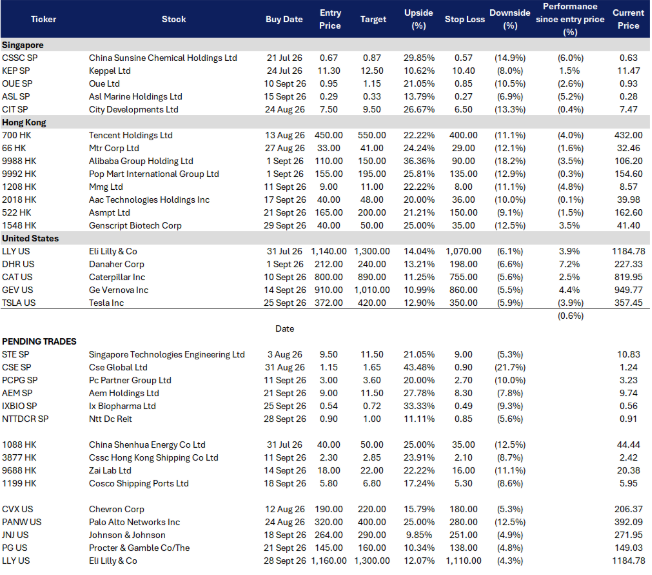
The sponsor ROFR pipeline includes roughly 130MW of identified near-term acquisition opportunities versus the current portfolio of about 91MW, with management targeting deployment over the next three to five years. NTT DC REIT also joined the FTSE EPRA Nareit Global Developed Index on 21 September, which should broaden institutional ownership and improve liquidity. With units closing at US$0.92 on 24 September versus UOB’s US$1.31 target, the current price offers an attractive setup if committed leasing converts into revenue and the first sponsor-backed acquisition is executed without excessive equity dilution.

IXBIO SP
US defence validation, Wafermine regulatory de-risking, and US commercialisation
KEY INSIGHTS #1
US military demand for non-opioid pain treatment has materially de-risked Wafermine.
The core thesis has shifted from speculative drug development toward a US-government-funded programme. In February 2026, iX secured a US$40.95M sole-source contract from the US Department of Defense to fund Wafermine’s Phase 3 development and work toward Emergency Use Authorization, with the programme running over 36 months. The latest September development is more important: the US government has now formally opened the military emergency-use pathway for moderate-to-severe acute pain, satisfying the statutory precondition for the FDA to consider Wafermine for EUA. iX expects to complete its EUA submission by 4Q26, making regulatory execution the key near-term catalyst.
KEY INSIGHTS #2
EUA approval could bring commercial revenue forward substantially.
The September declaration means Wafermine could potentially be deployed to authorised US military personnel before full FDA approval if the FDA grants EUA. That would be strategically important because it could convert Wafermine from a development-funded asset into a procurement opportunity while Phase 3 continues. iX is also establishing manufacturing capability in Nevada and has around 40 products targeting the US compounding-pharmacy channel, providing a second route to commercialisation. The stock has already rerated sharply to around S$0.58 from below S$0.20 earlier in 2026, so expectations are elevated, but a successful EUA filing and clearer procurement pathway could support another leg higher.

1548 HK
AI drug-discovery infrastructure, operating leverage, and ProBio value unlock
KEY INSIGHTS #1
Eli Lilly partnership validates GenScript as infrastructure for AI-driven drug discovery.
GenScript’s strongest new catalyst is its 16 September collaboration with Lilly TuneLab, Eli Lilly’s AI/ML drug-discovery platform. GenScript will provide wet-lab services that convert AI-generated drug predictions into experimentally validated biological data, positioning the company at the critical bridge between computational discovery and physical testing. This follows 1H26 AI-enabled drug-discovery revenue roughly doubling YoY for a third consecutive half. The market reacted strongly, with 1548 HK rising 14.3% on 17 September and another 5.7% the following day, suggesting investors are beginning to value GenScript as an AI-biotech infrastructure play rather than a conventional life-science reagent supplier.
KEY INSIGHTS #2
ProBio spin-off and fresh AI investment provide another valuation catalyst.
GenScript has received HKEX clearance to proceed with the proposed separate listing of ProBio while retaining control, creating an opportunity to crystallise the value of its fast-growing biologics and advanced-therapy CDMO franchise. Separately, the September share placement raised approximately HK$2.33B net, with around 70% earmarked for expanding AI-drug-discovery production capacity and infrastructure and another 20% for AIDD-related R&D, digital integration and global expansion. The stock has already rerated sharply to HK$39.74 from around HK$30 earlier in September, so chasing above HK$40 carries higher risk. A pullback toward HK$37.50 provides a cleaner entry while preserving upside from ProBio monetisation, continued AI-discovery growth and further operating leverage.

522 HK
Advanced packaging acceleration, TCB order momentum, and photonics upside
KEY INSIGHTS #1
AI packaging complexity is driving a broad-based backend equipment upcycle.
AI accelerators, HBM, chiplets and 2.5D/3D integration increasingly require more advanced packaging rather than relying solely on front-end transistor scaling. ASMPT is directly exposed through TCB, hybrid bonding, high-precision die bonding and photonics. 1H26 advanced-packaging revenue reached a record US$339M, +17% YoY and around 30% of group revenue, while photonics revenue nearly tripled as customers ramped 800G-and-above optical transceivers. This gives ASMPT diversified exposure to AI infrastructure across compute, memory and optical connectivity rather than a single packaging technology.
KEY INSIGHTS #2
Bookings suggest the earnings cycle still has room to run.
2Q26 bookings surged 97.6% YoY to US$903.6M, taking 1H26 bookings to US$1.63B and lifting book-to-bill to 1.43x, the highest since 1H21. Revenue rose 52.1% YoY in 2Q26 to US$630M, while adjusted gross margin expanded to 42.5% and adjusted net profit more than tripled to HK$637.5M. Importantly, ASMPT secured bulk orders for more than 50 chip-to-substrate TCB tools from OSAT customers for advanced AI chips, providing tangible evidence that TCB adoption is moving from qualification into volume deployment.

LLY US
Extending its growth runway through weekly insulin and pipeline expansion
KEY INSIGHTS #1
Onswik strengthens the diabetes franchise while external partnerships expand pipeline optionality.
The FDA approval of Onswik, Lilly’s once-weekly basal insulin for adults with type 2 diabetes, adds a differentiated treatment to an already broad cardiometabolic portfolio spanning insulin, incretins and other therapies. Onswik met its primary endpoint across the QWINT Phase III programme involving more than 3,400 patients and could reduce basal insulin injections from roughly 365 to 52 per year; alongside this, Lilly’s new InnoCare partnership targets up to five new drug programmes, with up to US$3.25bn of potential development and commercial milestones, broadening its longer-term discovery pipeline.
KEY INSIGHTS #2
Rising diabetes prevalence supports demand for simpler chronic-disease treatments.
Diabetes remains a structurally growing healthcare burden, with around 40.1mn Americans, roughly one in eight, living with the disease, while globally 589mn adults had diabetes in 2024 and this is projected to reach 853mn by 2050. As type 2 diabetes accounts for most cases, therapies that reduce treatment burden and improve convenience should become increasingly important, supporting long-term demand for differentiated products such as once-weekly insulin alongside Lilly’s broader cardiometabolic franchise.

TSLA US
U.S.-China policy optionality with autonomy as the next growth leg
KEY INSIGHTS #1
Trump-Xi talks could reduce policy uncertainty around Tesla’s China exposure.
The Trump–Xi summit is focused heavily on trade, technology access, rare-earth exports and the extension of the existing tariff truce, making any easing in U.S.–China tensions relevant for Tesla given the importance of its Shanghai operations and Chinese supply chain. Tesla remains highly exposed to China both as a manufacturing base and end market, while a more stable trade framework could reduce supply-chain and tariff uncertainty around batteries, components and cross-border production.
KEY INSIGHTS #2
Autonomy and China operations provide near-term catalysts.
Tesla’s more immediate growth catalysts are centred on autonomous driving and utilisation of its existing vehicle platform: the company has launched its Cybercab robotaxi service, while Europe is moving toward a key vote on broader FSD deployment after Tesla released supervised-driving safety data covering more than 100mn km. At the same time, China-made EV sales rose 3.6% YoY in August to 86,166 units, extending Tesla’s growth streak in Shanghai-made vehicles despite intensifying domestic competition.
STOCKS
STOCKS
STOCKS