
ASL SP
Ship-repair resilience, deleveraging, and Singapore infrastructure optionality
KEY INSIGHTS #1
An ageing regional fleet and sustained offshore activity support recurring ship-repair demand.
ASL Marine is increasingly positioned as a service-led marine play rather than a cyclical shipbuilder. Management expects ship-repair demand to remain resilient because of ageing vessels, regulatory maintenance requirements, high vessel replacement costs and the technical complexity of repair work. Its Singapore and Batam yards also sit close to the Straits of Malacca, providing access to one of the world’s busiest shipping corridors. FY26 ship-repair demand remained resilient while group revenue increased 3.0% YoY to S$360.7M, giving ASL relatively defensive exposure to the broader marine and offshore upcycle.
KEY INSIGHTS #2
Singapore’s S$100B coastal-protection programme creates a multi-year chartering and dredging opportunity.
ASL has direct exposure to land reclamation, dredging, port development and marine infrastructure through its chartering fleet and dredging capabilities. Singapore’s planned S$100B coastal-protection programme, together with the proposed New Western Island development around Jurong Island, could drive long-duration demand for dredging and marine construction vessels. ASL already ended FY26 with approximately S$61M of long-term ship-chartering contracts, while management is selectively rebuilding its shipbuilding order book toward higher-value projects.

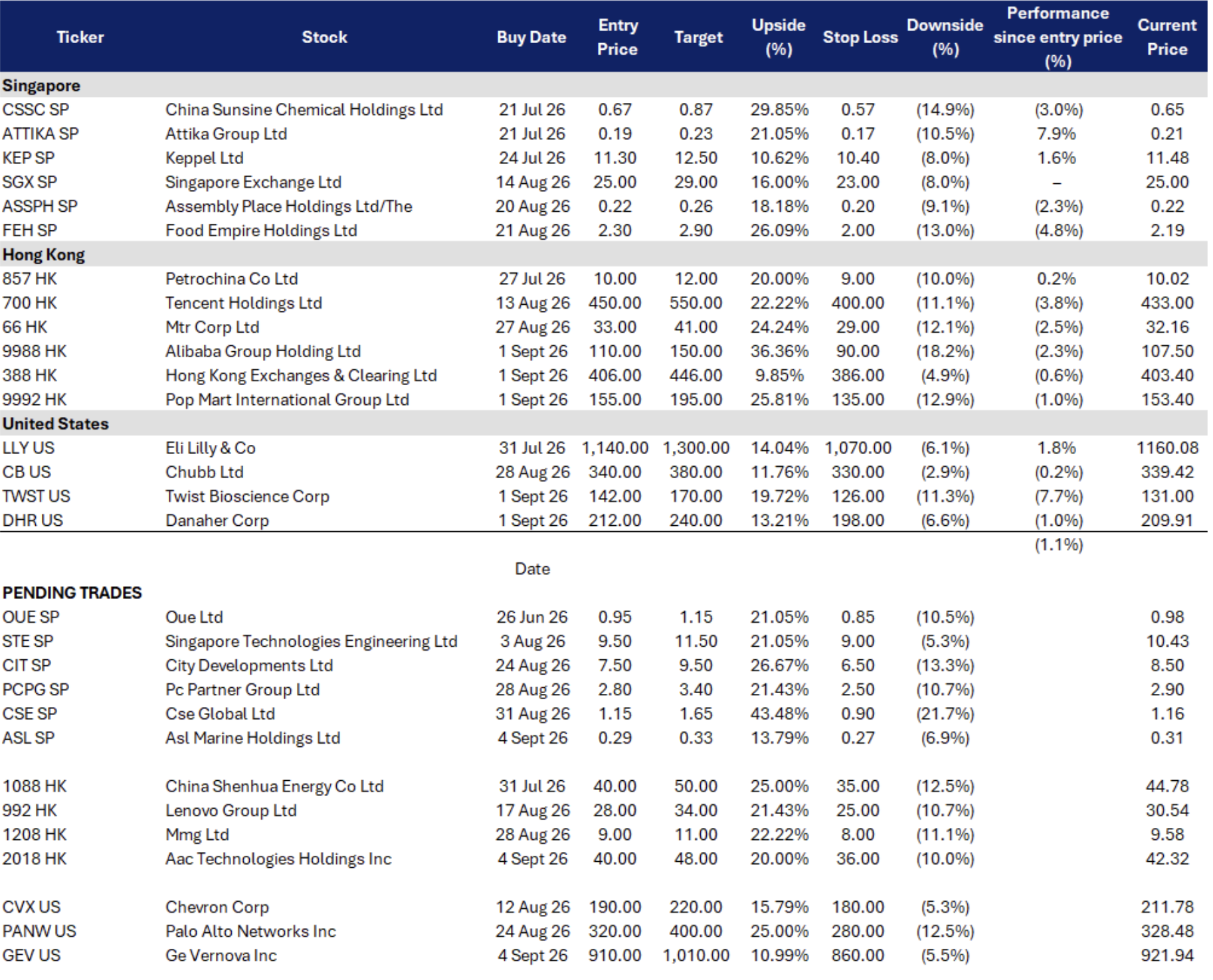
CSE SP
AI data-centre electrification, record backlog conversion, and strategic-review optionality
KEY INSIGHTS #1
AI data-centre power infrastructure is becoming the main structural growth engine.
CSE is increasingly exposed to the second-order beneficiaries of AI capex rather than GPUs themselves. Data-centre infrastructure already contributed around 14% of group revenue in 2025, while Amazon’s warrant arrangement is tied to up to US$1.5B of qualifying purchases of CSE products and services through November 2030. More recently, CSE secured a US$49.8M, or S$64.3M, contract to design and manufacture power distribution centres for the Cheyenne Power Hub in the US, with execution across 2026–27. The win validates CSE’s position in critical electrical infrastructure and creates potential follow-on opportunities as hyperscalers continue expanding US power capacity.
KEY INSIGHTS #2
Strategic review creates additional upside beyond the operating recovery.
CSE has continued to update investors that its strategic review remains ongoing, providing potential optionality around capital allocation, corporate structure or other value-unlocking measures. At the same time, the operational catalyst pipeline remains strong, with brokers expecting further large hyperscaler electrification awards and the recently secured Cheyenne project adding to FY27 visibility. With the shares around S$1.18–1.20 versus recent analyst targets ranging from roughly S$1.56 to S$1.95, the current valuation offers an attractive setup if 2H26 margins recover while the strategic review produces a tangible outcome.

2018 HK
Thermal-management breakout, AI hardware optionality, and margin expansion
KEY INSIGHTS #1
AI hardware is opening a new component cycle beyond smartphones.
Smartphone demand remains soft, but AAC is increasingly exposed to higher-growth applications requiring more sophisticated thermal, acoustic and mechanical components. In 1H26, heat-dissipation revenue surged around 400% YoY to RMB1.1B, driven by ultra-thin vapour chambers, while the company has begun batch deliveries of 2.2MW and 2.6MW liquid-cooling CDUs for data-centre applications. Management expects several new businesses including thermal management, AI devices, liquid cooling and robotics to contribute RMB8–9B of revenue in 2027, materially reducing AAC’s historical reliance on handset volumes.
KEY INSIGHTS #2
Thermal and liquid cooling could become the FY27 earnings revision driver.
Management expects precision mechanics and thermal-management revenue to grow more than 30% in FY26, while liquid-cooling revenue is beginning from a small base and should accelerate as AI-server power density rises. Monthly CDU capacity already exceeds 600 units, while management sees thermal VC and active-cooling revenue potentially exceeding RMB5B in 2027. The shares are around HK$42–43, versus an average analyst target of roughly HK$53 and DBS at HK$58. If thermal and AI-related revenue ramps as guided through 2H26, consensus earnings revisions could increasingly outweigh the ongoing smartphone slowdown.

9992 HK
IP diversification, overseas normalization, and buyback support
KEY INSIGHTS #1
Designer toys are shifting from a China collectible trend into a broader global IP consumption category.
Pop Mart’s 1H26 revenue increased 23.8% YoY to RMB17.17B, demonstrating that demand remains structurally above pre-LABUBU levels despite a sharp slowdown from 2025’s exceptional growth. More importantly, revenue is broadening beyond a single viral character: six IPs generated more than RMB1B each during the half, including THE MONSTERS at RMB4.45B, Stars at RMB2.65B, CRYBABY at RMB1.63B, DIMOO at RMB1.62B, SKULLPANDA at RMB1.55B and HIRONO at RMB1.01B. A deeper multi-IP portfolio reduces reliance on LABUBU alone and gives Pop Mart greater potential to evolve toward a Disney-style IP monetisation model rather than remaining a conventional toy retailer.
KEY INSIGHTS #2
Overseas weakness looks more like channel normalization than a collapse in brand demand.
The key 1H26 disappointment was international revenue, which fell 9.1% as online traffic normalized from unusually strong 2025 levels and overseas operating margins were pressured by store openings and weaker scale leverage. However, offline overseas stores remained comparatively healthy, while management is shifting from aggressive store rollout toward stricter site selection and localized supply. Pop Mart has also added manufacturing partners in Mexico, Cambodia and Indonesia, which should shorten replenishment cycles and reduce reliance on air freight. If inventory normalization continues through 2H26, overseas margins could recover without requiring aggressive discounting that would damage IP scarcity and brand equity.

GEV US
Power-infrastructure leader leveraged to the global electricity and AI data-centre buildout
KEY INSIGHTS #1
Record backlog and expanding power-to-rack offering improve earnings visibility.
GE Vernova’s order book continues to strengthen, with 2Q26 orders rising 88% organically to US$24.2bn, backlog reaching US$176bn, and data-centre orders exceeding US$5bn year-to-date, more than double the full-year 2025 level. The company is expanding gas-turbine capacity toward 30GW annually by 2030, while new products such as its medium-voltage UPS extend its offering from generation and grid connection all the way into the data centre, strengthening its position across the entire “power-to-rack” value chain.
KEY INSIGHTS #2
Surging electricity demand is accelerating investment across generation and grids.
Rapid growth in AI data centres, electrification and renewable-energy deployment is forcing utilities to add generation capacity and modernise transmission networks, creating structural demand for gas turbines, transformers, switchgear, HVDC and nuclear technologies. GE Vernova is positioned across these bottlenecks, from National Grid’s major transmission upgrades in the UK to its BWRX-300 nuclear programme in Sweden, giving it exposure to both near-term grid spending and longer-term baseload power investment.

TWST US
DNA synthesis platform leveraged to AI-driven biotech discovery
KEY INSIGHTS #1
DNA synthesis is scaling with improving margins.
Twist is benefiting from rising demand across DNA synthesis, protein solutions and NGS, with 3Q26 revenue up 23% YoY to US$118.4mn, marking its 14th consecutive quarter of sequential growth. DNA Synthesis and Protein Solutions revenue grew 39% YoY to US$56.6mn, while gross margin improved to 52.8%, showing that higher utilisation and product mix are supporting both growth and operating leverage.
KEY INSIGHTS #2
AI drug discovery and personalised medicine increase demand for synthetic DNA.
AI-enabled drug discovery is accelerating the design of proteins, antibodies and therapeutic candidates, increasing the number of biological sequences that need to be physically synthesised and tested. The recent Phase III success of Moderna and Merck’s personalised mRNA cancer vaccine also highlights the broader shift toward genomics-driven and personalised therapies, where sequencing, mutation identification and rapid DNA synthesis become increasingly important research tools.
STOCKS
STOCKS
STOCKS