
ASSPH SP
Asset-light key growth, new living verticals, and Phoenix Park as the next scale catalyst
KEY INSIGHTS #1
The growth story is broadening beyond conventional co-living.
TAP ended FY25 with 3,422 keys across 100 properties, versus 2,106 keys at end-FY24, while average occupancy improved to 94.4% from 91.0%. It already commands about 34% of Singapore’s co-living market by keys and targets more than 10,000 keys by end-2030. More importantly, 2026 expansion is no longer just adding ordinary rooms. TAP has moved into migrant-worker accommodation through a 60:40 JV with S11, adding 886 beds, while also expanding into hotels and other living formats.
KEY INSIGHTS #2
FY25 proves the asset-light model can scale, but watch the lease mix.
FY25 revenue increased 42.4% YoY to S$27.0m, while net profit rose 6.4% to S$6.6m. Excluding approximately S$1.1m of non-recurring IPO expenses, adjusted NPAT increased 24.2% to S$7.7m. The key operating metric is occupancy: 94.4% alongside rapid key expansion suggests TAP has so far been able to add supply without sacrificing utilisation. Community-Driven Stays generated 93.3% of FY25 revenue, with segment revenue rising 41.9% to S$25.2m.

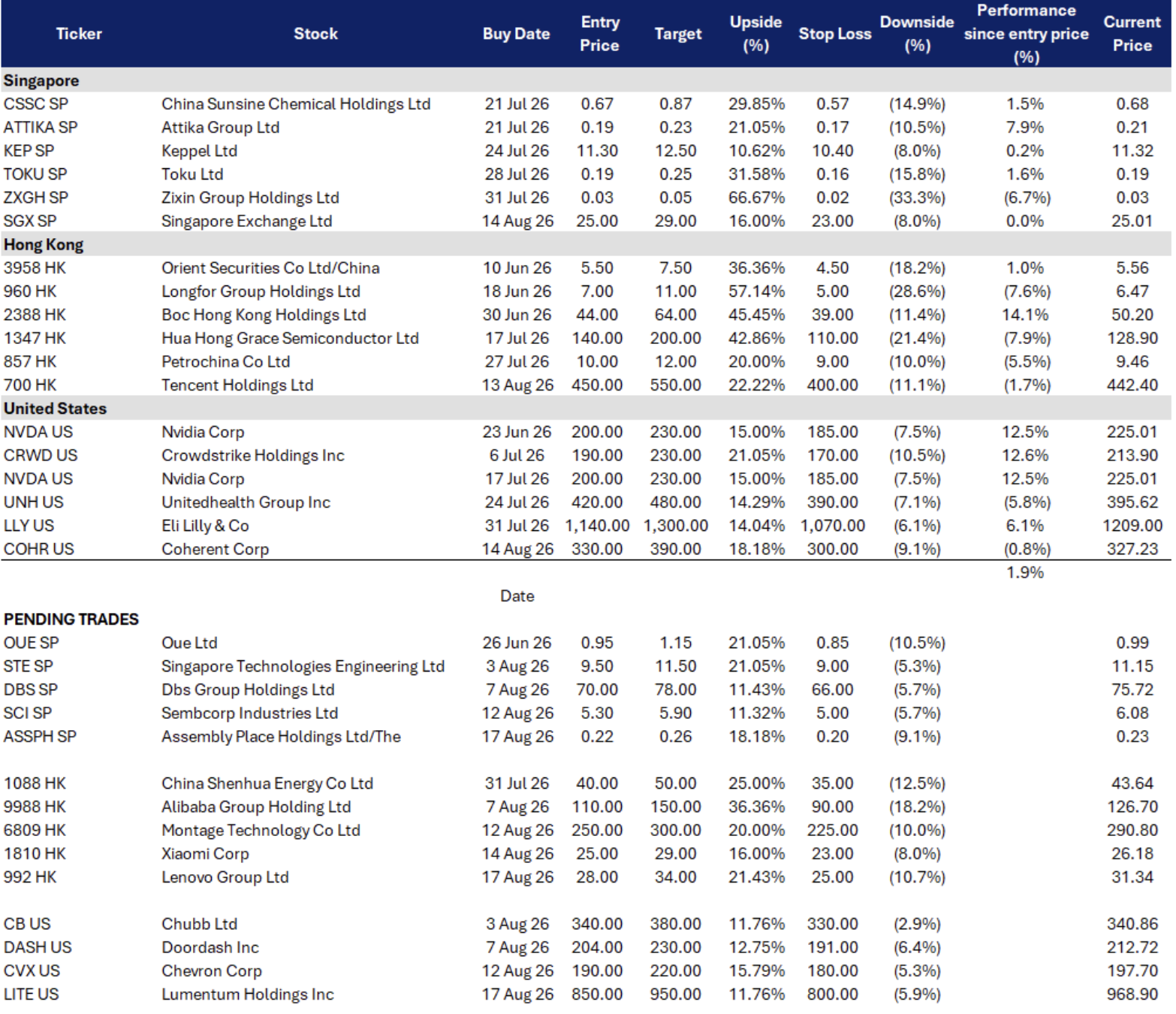
SGX SP
Cash-equities revival, record FICC volumes, and capital returns create a higher-quality earnings mix
KEY INSIGHTS #1
Singapore equity-market revival has finally become an earnings driver.
This is the biggest change to the SGX thesis. FY26 cash-equities net revenue surged 28.1% YoY and now contributes more than one-third of group revenue. Singapore also hosted 21 equity listings versus six in FY25, raising S$4.1B. The liquidity improvement is equally important. In May 2026, securities market turnover jumped 70% YoY to S$45.8B, while securities daily average value increased 79% to S$2.4B, its highest level since October 2007. Activity outside STI constituents has also accelerated, suggesting the recovery is broadening beyond banks and large caps.
KEY INSIGHTS #2
FICC means SGX no longer needs Singapore IPOs alone to grow.
FY26 FICC net revenue increased 17% to S$376.1M, approximately 25.5% of group revenue, with FX and commodities reaching new volume records. This is strategically important. SGX’s FX, iron ore, freight and other derivatives franchises monetise volatility and Asian cross-border flows rather than relying solely on Singapore’s domestic economy.

992 HK
AI server inflection, PC pricing power, and a US$54bn AI pipeline
KEY INSIGHTS #1
AI infrastructure has reached an inflection point — US$54bn pipeline changes the earnings narrative.
Management reiterated a 550,000-unit FY27 1Q results were substantially stronger than expected. Revenue surged 43% YoY to US$26.94bn, versus consensus around US$22.3bn. AI-related revenue increased 60% to US$9.3bn and now represents roughly 35% of group revenue. More importantly, Lenovo disclosed an AI-server pipeline of US$54bn, +157% QoQ. This is the number I would focus on. Lenovo is increasingly participating in the AI capex cycle through rack-scale servers, liquid cooling, storage and infrastructure integration rather than simply selling PCscontributor rather than an R&D drag.
KEY INSIGHTS #2
Memory inflation is surprisingly becoming a pricing-power test rather than an earnings killer.
The obvious bear case is rising DRAM and NAND prices. Lenovo is one of the world’s largest memory purchasers, so the current memory shortage should theoretically squeeze hardware gross margins. So far, Lenovo is managing it better than expected. Management is using its global procurement scale, diversified sourcing and PC price increases to offset component inflation. Despite memory shortages, last quarter delivered adjusted net income of US$1.075bn, more than doubling YoY.

1810 HK
AI memory-bandwidth bottleneck, DDR5 interface dominance, and new interconnect products driving margin expansion
KEY INSIGHTS #1
EV remains the strongest structural growth engine; 550k FY26 deliveries are the key bar.
Management reiterated a 550,000-unit 2026 EV delivery target after 1Q26 despite quarterly deliveries falling sequentially as the original SU7 transitioned and production was reallocated. The EV business generated roughly RMB19bn of 1Q26 revenue, while deliveries still increased 6.6% YoY. The important distinction is between temporary production/model-transition weakness and demand destruction. If Xiaomi can execute toward 550k units while maintaining ~20% automotive gross margins, the EV operation moves rapidly toward becoming a meaningful standalone earnings contributor rather than an R&D drag.
KEY INSIGHTS #2
Xiaomi’s longer-term multiple increasingly depends on proving the “Human × Car × Home” ecosystem actually monetises.
The strategic attraction is the interaction between Xiaomi’s installed smartphone/IoT base and EV ownership. Cars potentially increase ecosystem stickiness across phones, wearables, appliances, AI assistants and connected-home products. That ecosystem thesis becomes much more valuable if Xiaomi successfully expands its EV business internationally.

LITE US
AI optics bottleneck, 1.6T/CPO acceleration, but valuation now demands near-perfect execution
KEY INSIGHTS #1
Optics content per GPU cluster is structurally increasing.
AI clusters require rapidly increasing bandwidth between GPUs, racks and data centres. As speeds migrate from 400G/800G toward 1.6T and beyond, copper becomes progressively less practical across longer connections, increasing optical content. Lumentum’s 4Q26 numbers provide unusually strong evidence that this is already translating into demand: quarterly revenue reached US$1.01B, +109% YoY, while management’s September-quarter guidance jumped to US$1.225–1.275B.
KEY INSIGHTS #2
1.6T is the near-term earnings driver; CPO is the next content step-up.
The market tends to focus on CPO, but I would not make CPO the FY27 base case. The nearer-term earnings torque comes from conventional pluggable optics moving toward 1.6T, together with higher-speed EML and pump-laser demand. CPO then provides upside optionality. Instead of connecting switches and accelerators to remotely positioned optical modules, CPO moves optics much closer to the switching silicon. That requires highly reliable external laser sources, an area where Lumentum’s photonics expertise becomes particularly valuable.

COHR US
AI optics demand is accelerating faster than capacity; 1.6T + InP are the key earnings engines
KEY INSIGHTS #1
AI networking is moving from 800G → 1.6T, and optical content per GPU cluster keeps rising.
AI clusters are becoming increasingly constrained by bandwidth, distance and power consumption. That drives faster adoption of optical connectivity as clusters scale to hundreds of thousands of accelerators. Coherent’s FY4Q26 revenue reached US$2.05B, +34% YoY, above consensus around US$1.99B, while adjusted EPS reached US$1.74 versus approximately US$1.62 expected. Management attributed the strength to exceptionally strong datacenter and communications demand.
KEY INSIGHTS #2
CPO creates another TAM rather than ending the pluggable-optics cycle.
Coherent supplies technology across several architectures: silicon photonics, InP, VCSEL, high-power CW lasers and optical components. Management is already developing multiple CPO architectures. So the transition from pluggable optics → near-packaged optics → CPO potentially shifts where Coherent’s content sits rather than removing it.
STOCKS
–
STOCKS
–
STOCKS
–