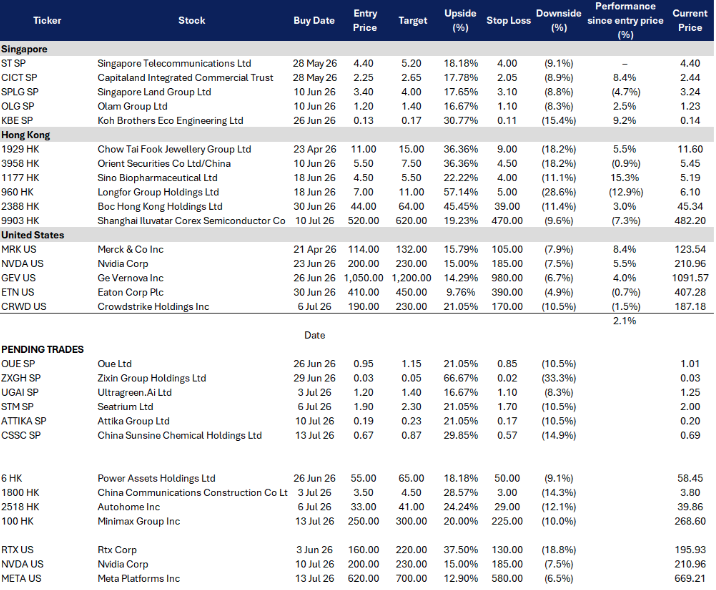

CSSC SP
Record volumes, captive MBT cost advantage, and net cash covering two-thirds of market value
KEY INSIGHTS #1
Tyre production and replacement demand support continued volume growth.
China Sunsine sold a record 222,243 tonnes of rubber chemicals in FY2025, up 4% YoY, despite intense price competition. Insoluble sulphur was the strongest category, with volume rising 14%, while international volume increased 5% as Chinese tyre manufacturers expanded production in Southeast Asia. The group supplies more than three-quarters of the global top 75 tyre makers, giving it broad exposure to both original-equipment and replacement-tyre demand.
KEY INSIGHTS #2
The balance sheet provides an unusually strong valuation floor.
China Sunsine ended FY2025 with RMB2.33B of cash, no bank borrowings and net cash equivalent to approximately S$0.45 per share. At a share price around S$0.67–0.68, cash represents roughly two-thirds of the market value. The company also adopted a policy to distribute at least 40% of adjusted net profit for FY2025 and FY2026, improving the likelihood that excess cash reaches shareholders.
ATTIKA SP
Data-centre fit-out pivot, high-spec contracts, and small-cap dividend support
KEY INSIGHTS #1
Data-centre and clean-room pivot gives Attika a higher-quality growth angle.
Attika secured S$26M of new contracts in November 2025, with the largest being a Singapore data-centre interior fit-out contract representing close to 80% of the combined value. The same announcement also included a clean-room contract for the automotive and industrial sector, which is strategically important because data centres, clean rooms and advanced manufacturing fit-out work have higher technical entry barriers than ordinary office refurbishment.
KEY INSIGHTS #2
Better margin and dividend policy create a small-cap yield/value support.
Despite lower FY2025 revenue, Attika reported 19.3% net profit growth to S$3.4M, supported by gross margin expansion to 20.5% from 15.1% in FY2024. The company also aims to distribute a 35% dividend payout for FY2026 and FY2027, which matters for a thinly traded small-cap because capital return can help anchor valuation while investors wait for data-centre revenue conversion.

100 HK
M3 product validation, global monetisation, but HK$16B fundraising resets the valuation
KEY INSIGHTS #1
M3 shifts MiniMax toward coding agents and higher-value enterprise workloads.
MiniMax released M3 in June 2026, targeting coding, agentic workflows and long-duration tasks rather than only consumer-facing generative AI. The model supports native image and video inputs and a context window of up to one million tokens. Its proprietary MiniMax Sparse Attention architecture is designed to lower the computational burden of long-context inference. This is commercially important because coding and enterprise-agent workloads generally provide clearer usage-based monetisation than consumer AI applications alone.
KEY INSIGHTS #2
Revenue growth and international traction are strong, but monetisation remains early.
FY2025 revenue increased 158.9% to US$79.0M, with more than 70% generated outside China. Revenue growth was supported by both AI-native applications and the company’s open-platform and enterprise-services business. Gross profit increased more than fivefold to US$20.1M, while gross margin improved from 12.2% to 25.4%, reflecting better model efficiency and infrastructure allocation. The international mix differentiates MiniMax from China AI peers that depend more heavily on domestic government or enterprise contracts.

9903 HK
Domestic GPU scarcity, ByteDance optionality, and capital raise overhang
KEY INSIGHTS #1
China AI compute substitution is the core scarcity trade.
The stock is a direct beneficiary of China’s push to build domestic alternatives to Nvidia, especially as US export restrictions continue to reshape AI accelerator procurement. Reuters reported that ByteDance is in talks with Iluvatar CoreX to buy inference chips, which would be a meaningful commercial milestone because Iluvatar has historically been more exposed to government procurement. A ByteDance win would validate the product outside state-linked channels and move the stock from “policy proxy” toward “commercial AI supplier”.
KEY INSIGHTS #2
Capital raise funds the roadmap, but creates near-term supply pressure.
Iluvatar is raising about HK$7.07B via a new H-share sale at HK$476 per share, a 15% discount to its prior close, with proceeds for R&D, product iteration and technology upgrades. Strategically, that is positive because AI chips are capital intensive and product cycles are unforgiving. Tactically, it creates overhang because the placement resets the near-term reference price and adds supply after a sharp post-IPO rally.

META US
Expanding from AI-enhanced advertising into a broader AI platform
KEY INSIGHTS #1
Meta is opening new AI monetisation channels beyond advertising.
Meta’s AI strategy is broadening from improving recommendations and ad targeting into directly monetising proprietary models. Muse Image is being embedded across Meta AI, Instagram and WhatsApp, with future access for advertisers to create marketing materials, while Muse Spark 1.1 introduces paid API access for coding and agentic tasks. Meta’s large consumer distribution gives it an advantage in rapidly deploying these products across billions of users, creators and businesses.
KEY INSIGHTS #2
Infrastructure and custom silicon support the shift toward scaled AI deployment.
As consumer and enterprise AI move from experimentation to production, Meta is building the computing capacity needed to compete with leading AI platforms. Its planned C$13bn Alberta data centre will begin at 1GW and can scale to 1.8GW, while its in-house Iris AI chip is expected to enter production and reduce dependence on Nvidia and AMD. This gives Meta greater control over long-term AI costs and capacity, although delays in agent development show that execution remains a key risk.

NVDA US
AI infrastructure leader with China upside and a sustained product-cycle runway
KEY INSIGHTS #1
China reopening and the Rubin roadmap extend NVIDIA’s growth runway.
NVIDIA remains the leading full-stack AI computing platform, supported by its GPUs, networking, CUDA software and complete AI systems. China’s potential approval for selected companies such as Alibaba, ByteDance and DeepSeek to purchase limited quantities of H200 chips creates incremental revenue upside that was not included in management’s prior outlook, while the transition from Blackwell to the more powerful Rubin platform in 2H26 provides the next major product catalyst. However, China purchases may remain below 200,000 chips and require case-by-case approval, making this upside optional rather than part of the base case.
KEY INSIGHTS #2
AI infrastructure demand remains constrained by compute and memory supply.
Global demand for AI training and inference continues to exceed available computing capacity, supporting sustained spending on NVIDIA accelerators and associated infrastructure. Strong investor demand for SK hynix’s US listing, which was reportedly more than seven times oversubscribed, reflects expectations of continued growth in high-bandwidth memory, a critical component of NVIDIA’s AI systems. NVIDIA also expects the current memory-chip shortage to persist for several years, reinforcing the view that the broader AI infrastructure cycle remains supply-constrained rather than demand-limited.
STOCKS
STOCKS
STOCKS
–