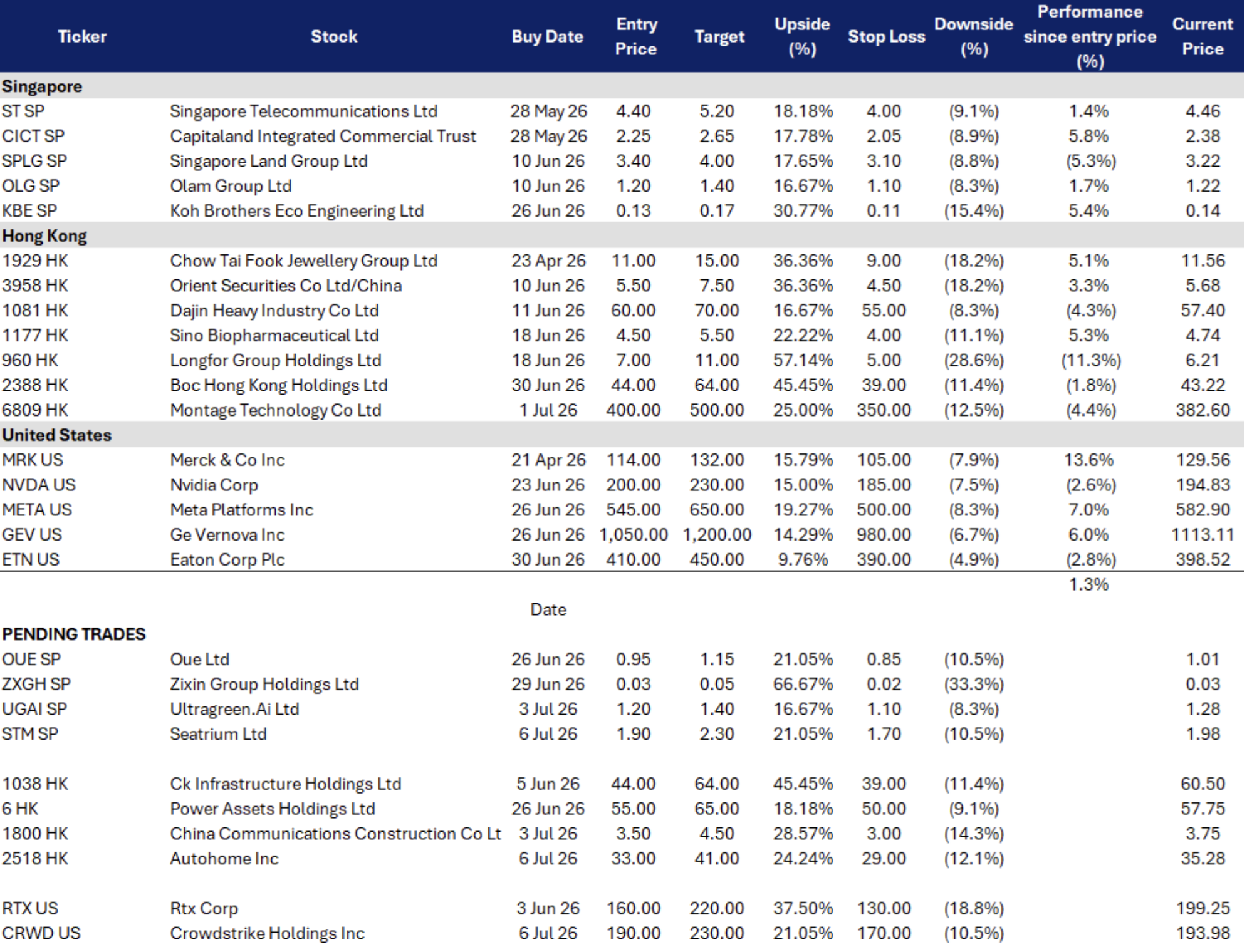

STM SP
FPSO backlog conversion, offshore upcycle, and execution credibility rebuild
KEY INSIGHTS #1
Deepwater oil capex remains supportive, with Petrobras FPSOs anchoring visibility.
Seatrium’s strongest near-term revenue visibility is still from large offshore production projects. The key anchor is the Petrobras P-84 and P-85 FPSO contracts, valued at about S$11B, with construction across Brazil, China and Singapore and final delivery expected in 2029. This matters because deepwater FPSO work is high-complexity and multi-year, giving Seatrium a stronger backlog profile than a short-cycle ship-repair name.
KEY INSIGHTS #2
Offshore wind risk is being ring-fenced, improving earnings quality.
The Maersk offshore wind vessel dispute was a key overhang, but Seatrium reached a settlement in December 2025, with Maersk to pay the remaining US$360M balance on a US$475M contract, including an interest-bearing credit arrangement for part of the amount. The vessel was around 99.8% completed at the time. This reduces uncertainty and supports the broader thesis that legacy project risk is being worked down, allowing investors to refocus on FPSO execution and new order conversion.

UGAI SP
Surgical imaging platform, ICG recurring revenue, and post-IPO medtech scarcity
KEY INSIGHTS #1
Fluorescence-guided surgery is moving from niche tool to standard-of-care workflow.
UltraGreen is positioned in the intersection of medtech, surgical imaging, and AI-enabled clinical workflow. The key industry angle is adoption: fluorescence imaging gives surgeons real-time visualisation beyond the naked eye, while the company’s platform combines ICG dye, imaging hardware and data tools. That creates a razor-and-blade structure where installed systems can support recurring ICG and software/data revenue over time.
KEY INSIGHTS #2
SGX scarcity premium, but post-IPO execution must catch up with valuation.
UltraGreen.ai listed on SGX in December 2025 at US$1.45 per unit, raising about US$400M in Singapore’s largest non-REIT IPO in eight years. The stock traded above IPO price on debut but has since pulled back from its post-listing high, creating a cleaner entry if the company can show revenue conversion, hospital adoption and M&A discipline. This is a medtech scarcity trade in Singapore, but it needs execution evidence to sustain a premium multiple.

2518 HK
China auto demand is still active, but platforms need to monetise differently
KEY INSIGHTS #1
China infrastructure remains a policy support tool, but growth is slower quality now.
China’s auto market remains high-volume and competitive, especially in EVs and lower-tier cities. That helps traffic and content relevance, but it also pressures legacy dealer lead-generation economics because automakers and dealers are spending more selectively. For Autohome, the market is no longer paying for “online auto portal dominance”; it needs evidence that the platform can monetise transactions, used-car services and data products at scale.
KEY INSIGHTS #2
Marketplace and new businesses are the optionality, but margins must prove durability.
The segment mix is changing. In 3Q25, online marketplace and others revenue rose to RMB816.4M from RMB617.8M a year earlier, while lead-generation revenue fell to RMB663.7M from RMB830.7M. That tells you exactly what the market is debating: legacy leads are declining, but transaction-led and marketplace revenue can offset if unit economics improve. The stock re-rates only if the new mix stops compressing margins.

1800 HK
Infrastructure policy carry, order-book visibility, but margin pressure caps the rerating
KEY INSIGHTS #1
China infrastructure remains a policy support tool, but growth is slower quality now.
CCCC is a direct proxy for China’s infrastructure stabilisation cycle. The macro angle is supportive but not explosive: infrastructure remains one of Beijing’s levers to cushion weak property and consumption, but local-government funding constraints mean the market will pay more for order quality, cash collection and margin discipline than headline contract wins. Fitch noted that China infrastructure investment growth is likely to remain subdued in 2026 because local-government funding capacity remains constrained, which frames CCCC as a value and dividend trade rather than a high-growth re-rating story.
KEY INSIGHTS #2
Cheap valuation plus dividend floor limits downside if margins stabilise.
The stock screens cheaply at around 4–5x P/E and offers a forward dividend yield of roughly 5% depending on price source. The company also stated in its 1Q26 announcement that it will maintain annual cash dividend payout at no less than 20%. This does not remove execution risk, but it gives investors a value floor while waiting for margin stabilisation.

CRWD US
Well positioned for a software rebound with accelerating recurring growth
KEY INSIGHTS #1
Falcon is expanding into the security control plane for enterprise AI.
CrowdStrike continues to expand beyond endpoint protection into cloud, identity, SIEM, browser and AI security through the unified Falcon platform. In 1Q27, revenue rose 26% YoY to US$1.39bn, ARR increased 24% to US$5.51bn and free cash flow reached a record US$468mn, prompting management to raise its full-year net new ARR growth guidance. Its partnerships with OpenAI, Anthropic, AWS, NVIDIA and major AI-gateway providers further strengthen Falcon’s position as a security control plane for enterprise AI adoption.
KEY INSIGHTS #2
Software rotation and AI-driven cyber risks support a re-rating.
Investors are beginning to revisit beaten-down software names after concerns over AI disruption drove a broad sector sell-off, favouring companies with durable recurring revenue and clear AI monetisation. Cybersecurity is particularly well positioned because rising AI infrastructure investment also increases the number of cloud workloads, agents, identities and data flows requiring protection, supporting resilient security budgets and potential valuation recovery for CrowdStrike.

ETN US
Grid-to-chip power infrastructure leader for AI data centres
KEY INSIGHTS #1
Strong orders and Boyd Thermal expand Eaton’s data centre exposure.
Eaton’s 1Q26 sales rose 17% YoY to a record level, while rolling 12-month orders in Electrical Americas increased 42% YoY, primarily driven by data centre demand, supporting its decision to raise 2026 organic growth guidance to 9%-11%. The acquisition of Boyd Thermal also adds liquid-cooling capabilities, allowing Eaton to offer a broader grid-to-chip portfolio covering electrical distribution, power management and thermal infrastructure.
KEY INSIGHTS #2
Rising rack density increases power and cooling content per data centre.
As AI servers become more power-intensive, data centres require substantially more electrical distribution, backup power, power conversion and liquid cooling equipment than traditional facilities. This increases the infrastructure content required per megawatt and supports sustained demand for Eaton’s integrated electrical and thermal solutions as hyperscalers expand AI capacity and modernise power architecture.
STOCKS
–
STOCKS
–
STOCKS
–