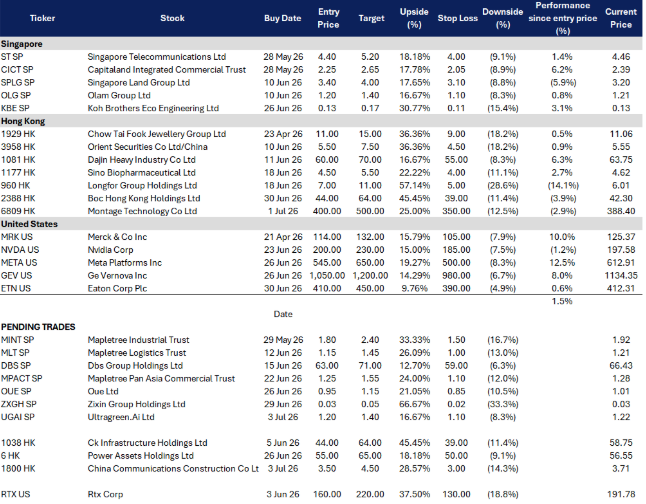
UGAI SP
Surgical imaging platform, ICG recurring revenue, and post-IPO medtech scarcity
KEY INSIGHTS #1
Fluorescence-guided surgery is moving from niche tool to standard-of-care workflow.
UltraGreen is positioned in the intersection of medtech, surgical imaging, and AI-enabled clinical workflow. The key industry angle is adoption: fluorescence imaging gives surgeons real-time visualisation beyond the naked eye, while the company’s platform combines ICG dye, imaging hardware and data tools. That creates a razor-and-blade structure where installed systems can support recurring ICG and software/data revenue over time.
KEY INSIGHTS #2
SGX scarcity premium, but post-IPO execution must catch up with valuation.
UltraGreen.ai listed on SGX in December 2025 at US$1.45 per unit, raising about US$400M in Singapore’s largest non-REIT IPO in eight years. The stock traded above IPO price on debut but has since pulled back from its post-listing high, creating a cleaner entry if the company can show revenue conversion, hospital adoption and M&A discipline. This is a medtech scarcity trade in Singapore, but it needs execution evidence to sustain a premium multiple.
ZXGH SP
Sweet-potato value-chain scaling, Hainan replication, and ODM margin recovery
KEY INSIGHTS #1
Rural revitalisation plus Hainan replication gives Zixin a bigger addressable runway.
The core upside is no longer only Liancheng sweet-potato snacks. Zixin is extending its model beyond Fujian, with Hainan positioned as the first meaningful replication market. The investment case is that Zixin’s integrated model of seedlings, cultivation, processing, cold-chain and waste recovery can be sold into other state-linked or cooperative farmland systems. That turns the story from a small branded-food manufacturer into a repeatable rural-industrialisation platform.
KEY INSIGHTS #2
ODM and processed products can lift revenue quality if margins stabilise.
Zixin’s processed snack and functional-food business remains the higher-quality driver. In 1H FY2026, revenue rose 40.8% YoY to RMB220.6M, driven mainly by processed snacks and functional foods, while net profit more than doubled to RMB16.1M. Gross margin normalised to 30.2% from 33.2%, broadly in line with management’s 30% target, suggesting the market should focus on volume scale and product mix rather than overreacting to some raw-material pressure.
1800 HK
Infrastructure policy carry, order-book visibility, but margin pressure caps the rerating
KEY INSIGHTS #1
China infrastructure remains a policy support tool, but growth is slower quality now.
CCCC is a direct proxy for China’s infrastructure stabilisation cycle. The macro angle is supportive but not explosive: infrastructure remains one of Beijing’s levers to cushion weak property and consumption, but local-government funding constraints mean the market will pay more for order quality, cash collection and margin discipline than headline contract wins. Fitch noted that China infrastructure investment growth is likely to remain subdued in 2026 because local-government funding capacity remains constrained, which frames CCCC as a value and dividend trade rather than a high-growth re-rating story.
KEY INSIGHTS #2
Cheap valuation plus dividend floor limits downside if margins stabilise.
The stock screens cheaply at around 4–5x P/E and offers a forward dividend yield of roughly 5% depending on price source. The company also stated in its 1Q26 announcement that it will maintain annual cash dividend payout at no less than 20%. This does not remove execution risk, but it gives investors a value floor while waiting for margin stabilisation.
6809 HK
Memory-interface scarcity, AI server torque, and China semiconductor scarcity premium
KEY INSIGHTS #1
AI servers are shifting the bottleneck from compute to memory bandwidth.
The cleanest angle is not generic “China chip” exposure, but memory-bandwidth scarcity. AI workloads need faster data movement between GPUs, CPUs and memory, and Montage’s DDR5 / MRDIMM ecosystem is directly exposed to that. Its Gen2 MRCD and MDB chipset supports DDR5 MRDIMM data rates up to 12,800 MT/s, aimed at next-generation computing platforms. That makes Montage a second-order AI infrastructure beneficiary: not the GPU itself, but a critical enabler of higher memory bandwidth.
KEY INSIGHTS #2
H-share listing creates a scarcity premium, but also makes this a high-beta tape trade.
Montage listed in Hong Kong in February 2026, raising about HK$7.04B, with the stock closing 64% above its IPO price on debut. The retail tranche was more than 700x oversubscribed, while the international tranche was more than 37x covered, showing unusually strong institutional and retail appetite for liquid China AI semiconductor exposure. That scarcity premium can persist, but it also means valuation is vulnerable when the AI-chip tape de-rates.

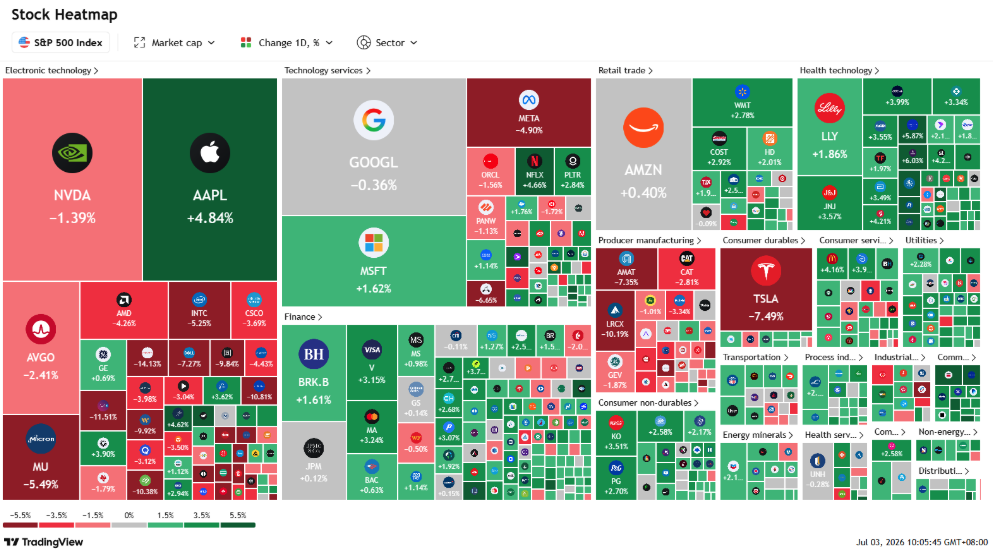
The United States market is closed today in observance of a public holiday (Independence Day). Trading resumes on Monday, 6 July 2026.
STOCKS
–
STOCKS
STOCKS