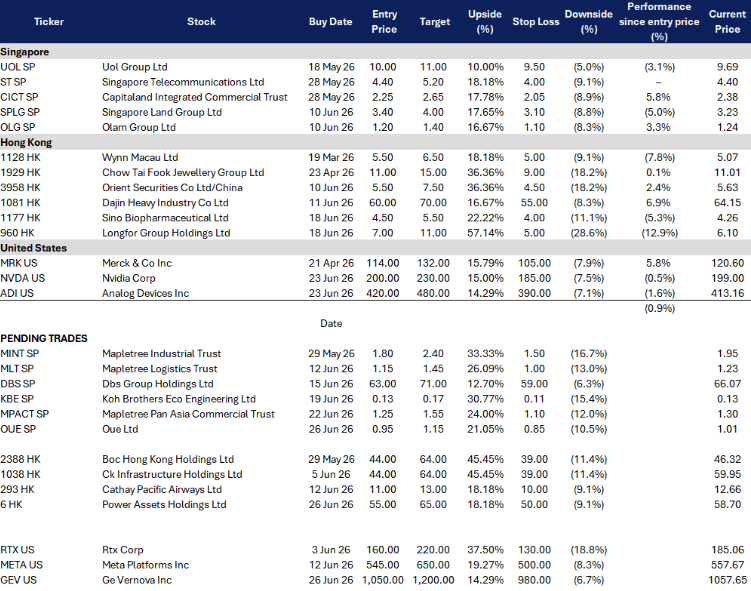
OUE SP
Airport-hotel expansion, REIT recovery, and deep NAV discount
KEY INSIGHTS #1
Crowne Plaza Changi Airport acquisition extends the hospitality platform.
OUE and Tokyo Century announced the acquisition of Crowne Plaza Changi Airport for S$500M, marking their second hotel collaboration at Singapore Changi Airport. This is the clearest near-term corporate action because it deepens OUE’s airport hospitality exposure at a globally relevant travel hub and reinforces management’s willingness to recycle capital into operating assets with tourism and aviation leverage.
KEY INSIGHTS #2
NAV discount is still too wide if asset values stabilise.
OUE reported NAV per share of S$3.85 at end-2025, while the share price is around S$1.05, implying the stock trades at roughly 0.27x P/NAV. The discount is justified by loss-making reported earnings and holdco complexity, but the gap becomes harder to ignore if hospitality improves, finance costs ease, and impairments at associates stop worsening.
MPACT SP
VivoCity strength, Festival Walk clean-up, and 6% yield carry
KEY INSIGHTS #1
Singapore retail remains the earnings anchor.
The core positive is VivoCity, which remains the best asset in the portfolio and continues to benefit from resilient suburban and destination retail demand. In FY24/25, VivoCity delivered full-year revenue growth of 3.5%, NPI growth of 2.1%, tenant sales above S$1B for the third consecutive year, committed occupancy of 99.3%, and rental reversion of +16.8%. That is still the cleanest reason to own the REIT.
KEY INSIGHTS #2
Festival Walk divestment helps clean up the balance sheet and reduce overseas drag.
MPACT agreed to divest Festival Walk Tower, the office component of Festival Walk in Hong Kong, for HK$1.96B or about S$328.1M, with completion targeted for February 2026. Proceeds are expected to be used for debt reduction, which should support gearing, lower funding pressure, and partially de-risk the weaker Hong Kong office exposure. This is not a transformational sale, but it is the right direction: recycle weaker non-core exposure and protect the balance sheet.

0006 HK
UKPN disposal unlock, defensive utility carry, and balance-sheet firepower
KEY INSIGHTS #1
UKPN disposal crystallises value and gives the balance sheet optionality.
Power Assets is participating in the disposal of UK Power Networks, with HKEX filings showing the transaction was formally announced in February 2026 and followed by an EGM circular in April 2026. This is the key catalyst because UKPN is one of the group’s major UK regulated utility holdings. A successful completion would convert part of embedded asset value into cash, giving Power Assets more flexibility for acquisitions, deleveraging, special distributions, or reinvestment into energy transition assets.
KEY INSIGHTS #2
Low gearing gives M&A firepower in a utility sector where capital is scarce.
The group’s FY2025 recurring profit rose modestly, while third-party summaries of the annual results note net debt to net total capital of about 1% on a corporate basis. That is unusually conservative for a utility/infrastructure investor. In a sector where many peers are still managing higher funding costs, Power Assets’ balance sheet can become an offensive tool rather than just a defensive buffer.
1177 HK
Innovation sales scaling, global BD validation, and pipeline density
KEY INSIGHTS #1
Innovation mix is now the core rerating engine.
Sino Biopharm’s innovative product revenue reached RMB15.22B in 2025, up 26.2% YoY, and accounted for close to half of group revenue based on reported 2025 revenue of RMB31.83B. This matters because China pharma names rerate when revenue quality shifts from mature generics into innovative drugs with better pricing power, longer product cycles, and stronger BD optionality.
KEY INSIGHTS #2
Global pharma validation is becoming a repeatable catalyst.
The Sanofi rovadicitinib licensing deal is worth up to US$1.53B, including US$135M upfront and up to US$1.4B in milestones, giving worldwide rights to a China-approved blood-cancer drug. Separately, GSK partnered with Sino Biopharm’s CTTQ to supply bepirovirsen in mainland China, with China regulatory approval expected in 2027 and GSK expecting peak annual sales above £2B globally. These deals validate Sino’s R&D and commercial platform, and should lift market confidence in future out-licensing and in-licensing economics.
GEV US
Full-spectrum beneficiary of AI-driven power and grid investment
KEY INSIGHTS #1
Record orders and backlog provide multi-year growth visibility.
GE Vernova is benefiting across both power generation and grid equipment, with 1Q26 orders reaching US$18.3bn, backlog rising to US$163bn, and management raising its 2026 guidance. Its Electrification segment secured US$2.4bn of data centre equipment orders in one quarter, exceeding the whole of 2025, while the Prolec GE acquisition expands its transformer manufacturing and grid equipment capabilities in North America.
KEY INSIGHTS #2
AI power shortages are accelerating gas generation and grid upgrades.
AI data centres are creating a structural rise in electricity demand that existing grids cannot meet quickly enough, driving simultaneous investment in gas turbines, transmission equipment, transformers and renewable capacity. With data centre electricity consumption expected to more than double over the long term, GE Vernova is positioned across the full power value chain required to generate, transmit and manage this incremental demand.
ADI US
High-quality analog compounder with AI data centre upside
KEY INSIGHTS #1
Broad-based order recovery with high-margin AI exposure.
AI infrastructure is expanding analog content beyond GPUs. While AI demand is usually associated with GPUs and memory, data centres also need higher-density power management, optical connectivity and signal-chain solutions, which are key ADI product areas. This gives ADI a broader AI infrastructure angle, especially as WSTS expects the global semiconductor market to reach US$1.51tn in 2026, driven by AI infrastructure, HBM and accelerated computing demand.
KEY INSIGHTS #2
AI infrastructure is expanding analog content beyond GPUs.
While AI demand is usually associated with GPUs and memory, data centres also need higher-density power management, optical connectivity and signal-chain solutions, which are key ADI product areas. This gives ADI a broader AI infrastructure angle, especially as WSTS expects the global semiconductor market to reach US$1.51tn in 2026, driven by AI infrastructure, HBM and accelerated computing demand.
STOCKS
–
STOCKS
STOCKS