Sector Performance | Singapore | Hong Kong | United States | Trading Dashboard

United States

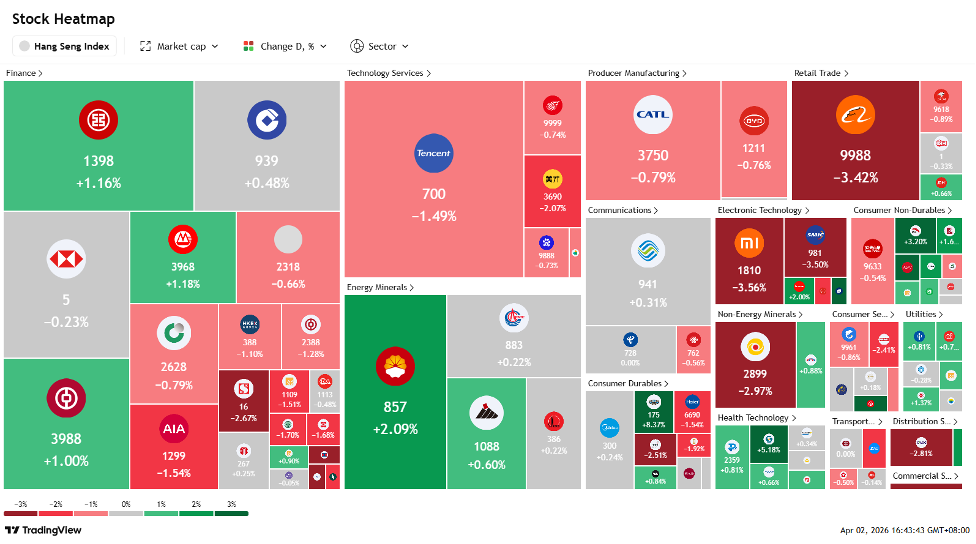
Hong Kong


RE-ITERATE BUY
OCBC Bank (OCBC SP)

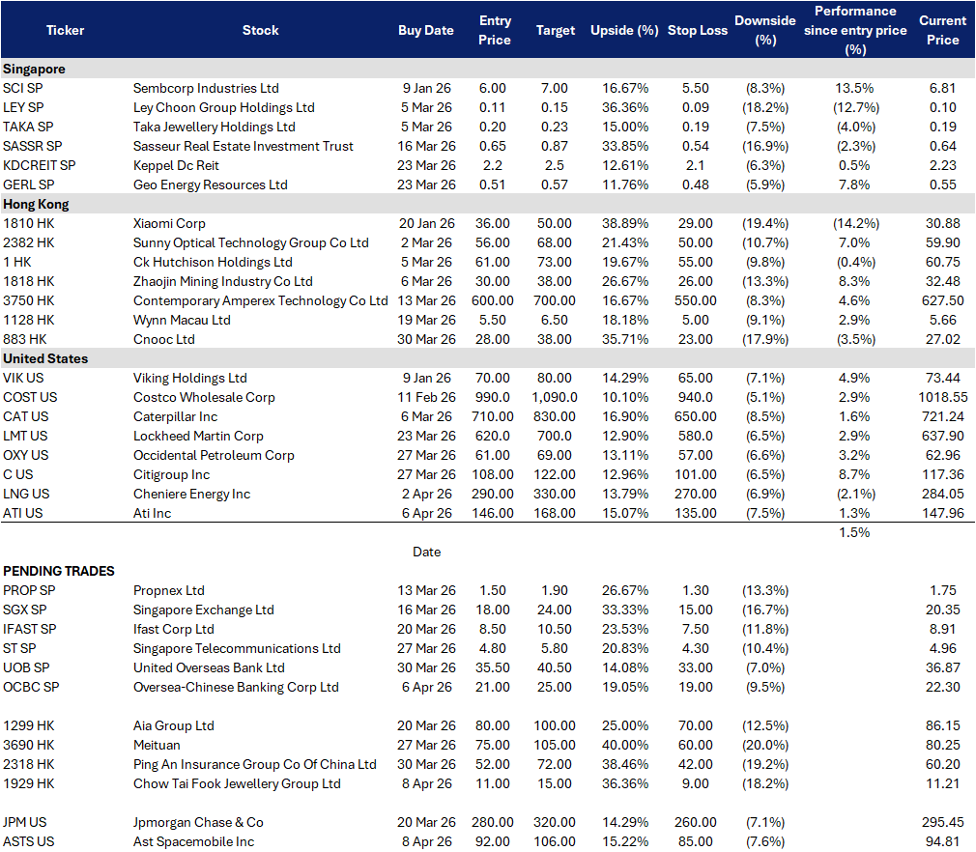
| Entry: 21 Target: 25 Stop Loss: 19 |
| Rate reset plus capital returns, with MAS Jan 29 as the policy anchor |
| Key Insights |
- Capital return is a real rerating lever and management is leaning on it. OCBC proposed ordinary dividend 42 cents and special dividend 16 cents for FY25, taking the total payout to 60% of earnings. Management also reaffirmed the ongoing S$2.5B two-year capital return plan through FY26, using special dividends and share buybacks, with commentary indicating a bias to special dividends when excess capital is available. This framework tightens downside and keeps the equity story simple even if NIM drifts lower.
- Diversified income is offsetting the NII downcycle. IFY25 profit before tax hit a new high of S$9.12B despite net profit being slightly lower year on year, as record total income and noninterest income strength partially offset lower net interest income in a declining rate environment. This matters because the market has historically underwritten OCBC at higher multiples when fees and insurance carry the slope.
RE-ITERATE BUY
United Overseas Bank Ltd (UOB SP)

| Entry: 35.5 Target: 40.5 Stop Loss: 33.0 |
| MAS 29 Jan tilt, fee momentum and ASEAN franchise, provisioning front loaded |
| Key Insights |
- MAS 29 Jan stance keeps the macro set-up constructive for banks. MAS kept the S$NEER policy band settings unchanged on 29 Jan 2026 while raising its 2026 inflation forecasts to 1.0% to 2.0% for both core and headline CPI, an outcome consistent with a steady growth and inflation backdrop. For UOB, a stable policy setting typically supports steady SORA conditions and a more predictable deposit pricing environment, which is the core requirement for NIM stability into FY26.
- Provisioning is front loaded, which sets up a cleaner 2026 slope. In 3Q25, UOB reported net profit of S$443M after setting aside an additional S$0.6B of pre-emptive general allowances to strengthen coverage. Management highlighted performing loan coverage strengthened to 1% and stated total credit costs are expected to normalise following this exercise, while also indicating the final dividend for 2025 would not be impacted by the pre-emptive allowance set aside. This is important because it reduces downside tail risk and improves earnings visibility for FY26 once the one-off provisioning drag rolls off.


BUY
Chow Tai Fook Jewellery Group (1929 HK)

| Entry: 11 Target: 15 Stop Loss: 9 |
| Mix upgrade is working, recovery tape is improving, overseas option value is rising |
| Key Insights |
- Mix upgrade is the real margin lever and it is showing up in the numbers. Fixed-price jewellery contribution expanded to 40.1% of retail sales value from 29.4% a year ago. This is the key margin driver because it reduces sensitivity to volatile gold prices and lifts gross profit per transaction. The market typically underwrites this late, meaning the mix shift can still support further multiple expansion if it holds through 1H26.
- Overseas expansion adds a second narrative and improves brand equity ahead of the centenary runway. The group opened a flagship store in Bangkok and communicated plans to open stores in Australia and Canada by end June 2026, with Middle East entry targeted within two years. Even if earnings contribution is initially modest, this builds option value and supports the brand transformation angle that the market is now paying for.
RE-ITERATE BUY
Ping An Insurance (2318 HK)

| Entry: 52 Target: 72 Stop Loss: 42 |
| NBV inflection is real, investment yield is back, and shareholder returns stay sticky |
| Key Insights |
- NBV is reaccelerating, and the mix shift is the right kind. FY2025 Life and Health NBV rose 29.3% to RMB36.897B, reflecting a shift toward higher-margin protection products and better productivity. This is the cleanest fundamental re-rating lever because the market still discounts China life insurers on “low growth plus low rates”. A sustained NBV slope change tends to drive multiple expansion faster than any single quarter of accounting profit.
- Investment performance has improved, which matters more in this tape. Ping An’s insurance funds investment portfolio grew 13.2% to RMB6.49T, and the company disclosed comprehensive investment yield of 6.3% for 2025. With Chinese equities supported by policy and AI-linked optimism, insurers that can generate stable investment returns typically see quicker earnings revision and sentiment lift, especially when NBV is already improving.

BUY
AST SpaceMobile Inc. (ASTS US)

| Entry: 92 Target: 106 Stop Loss: 85 |
| From technology validation to commercial constellation buildout |
| Key Insights |
- Commercialization is accelerating as AST moves from proof-of-concept to scaled deployment. AST SpaceMobile is entering its most important transition phase, moving from technology validation into early commercialization, with US$70.9mn of FY25 revenue, over US$1.2bn of contracted revenue commitments, and a launch cadence targeting 45 to 60 satellites in orbit by end-2026. The company’s recent milestones, including successful deployment of BlueBird 6, expected peak speeds above 120 Mbps, and new commercial agreements such as TELUS in Canada, support the case that AST is evolving into a real operating satellite network rather than a pure development story.
- Government and telecom partnerships strengthen funding, demand visibility, and strategic relevance. AST’s partner base now includes major telecom operators such as TELUS, Orange, Telefónica, CK Hutchison, Taiwan Mobile, Sunrise, Vodafone initiatives, and stc, while U.S. government traction is also building through a US$30mn SDA HALO Europa contract and positioning on the Missile Defense Agency’s SHIELD program. Combined with more than US$3.9bn of pro forma liquidity after its February 2026 financing, AST has both the strategic backing and the capital base to bridge toward broader commercial service activation by 2026.
RE-ITERATE BUY
ATI Inc. (ATI US)

| Entry: 146 Target: 168 Stop Loss: 135 |
| Benefitting from aerospace and defence Supercycle |
| Key Insights |
- Moat in jet engine materials. ATI has transformed into a leader in high-performance aerospace and defence alloys. The company currently produces 6 out of 7 advanced engine alloys, serves as the sole-source supplier for 5 of them, and holds a dominant position in jet engine core components. This competitive moat is being reinforced by a robust aerospace industry cycle: as of end-February 2026, Airbus had a backlog of 8,770 aircraft and Boeing approximately 6,734 aircraft. With OEM and MRO demand continuing to rise, long-term demand for ATI’s titanium, nickel, and cobalt-based products remains well-supported.
- Strong growth prospects in defence business. 4Q25 results demonstrate that the defence segment is already scaling up. Aerospace and defense accounted for 68% of Q4 revenue. With global defence spending reaching US$2.63 trillion in 2025, ATI is benefiting simultaneously from growing commercial engine demand and expanding requirements for defence materials across jet engines, airframes and mission-critical military platforms.


TAKE PROFIT
–
ADD
- ATI Inc (ATI US) at US$146
CUT
–